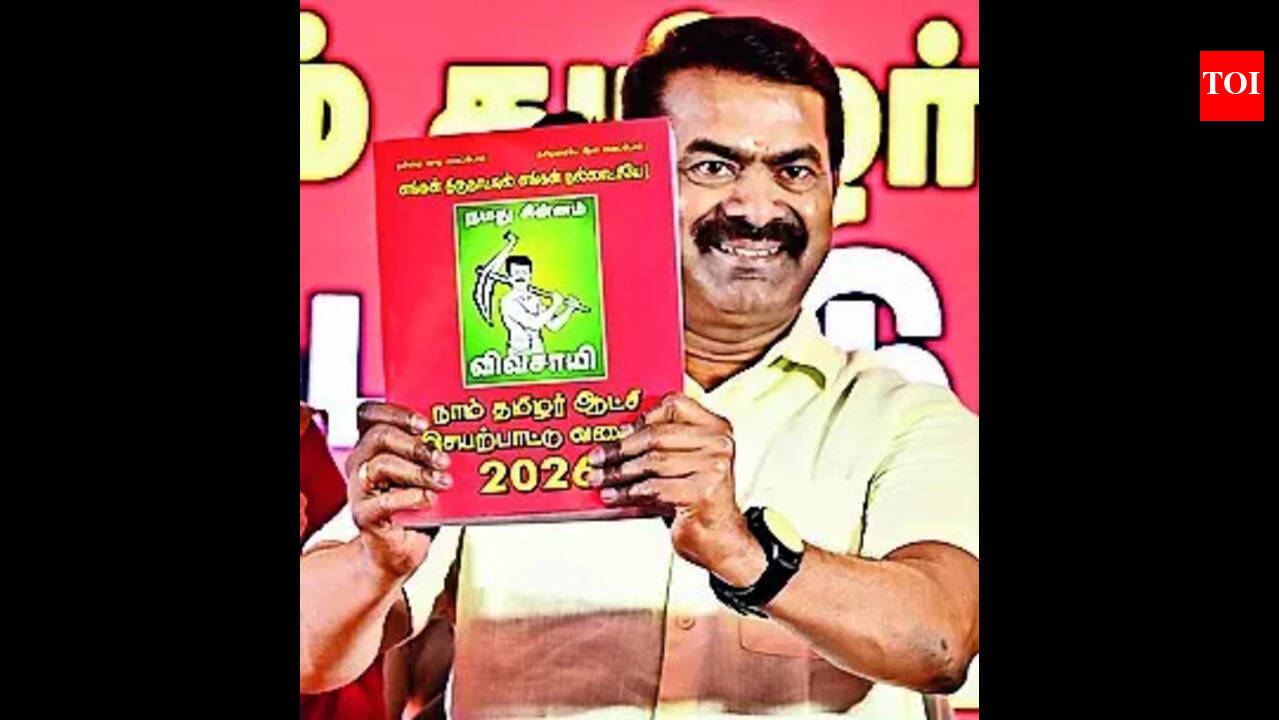
As election campaigning intensifies ahead of the April 23 Assembly poll, NTK has released a manifesto that shifts attention from routine promises to questions of decentralisation, federal power and institutional redesign.
The Tamil Nadu election debate sharpened this week after Naam Tamilar Katchi released its 2026 manifesto, a document that attempts to move the conversation beyond conventional promises and into the structure of governance itself. DT Next reported that the 462-page manifesto proposes a five-capital model for Tamil Nadu, a state-run railway system within the state, a Supreme Court bench in Tamil Nadu, and voting rights for Tamils living abroad.
Main manifesto highlights
What makes this manifesto stand out is not just the scale of the document, but the type of ideas it foregrounds. These are not short-cycle announcements designed only to create immediate electoral appeal. They are institutional proposals. A five-capital model would change how the state imagines administrative and regional balance. A state-run rail vision raises questions about federal power and transport planning. A Supreme Court bench in Tamil Nadu reopens a long-running debate on access to justice.
The five-capital proposal is likely to draw the most attention because it is the most visible and easiest to grasp. DT Next reports that the model assigns different functions to different cities, including Tiruchirappalli as administrative capital, Chennai as technology hub and Coimbatore as industrial and business centre. The attraction of such a model is obvious. It speaks to a recurring concern in Tamil Nadu: that Chennai concentrates too much institutional attention while other major centres remain underweighted in the official imagination of the state.
But the idea becomes harder the moment it moves from symbolism to execution. Multiple capitals require clarity on which departments move, which powers shift, how files and people move, what gets duplicated, and what remains centralised. Without that detail, a multi-capital structure can become more of a branding device than a working governance model.
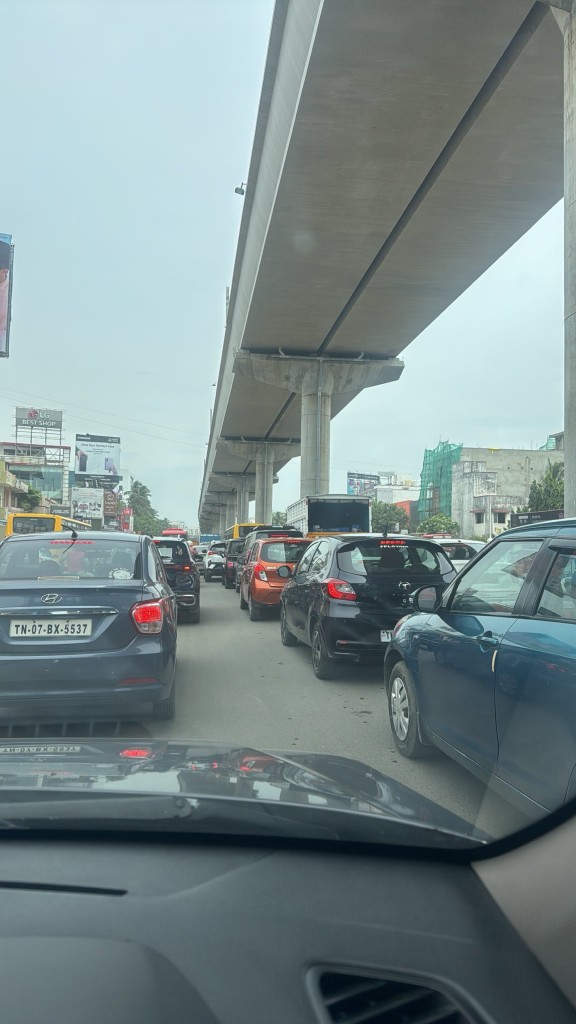
For OMR readers, this part of the manifesto has immediate relevance. OMR already shows what happens when economic growth outruns institutional adaptation. Congestion, infrastructure stress, housing pressure and uneven planning are all signs of concentration without balanced governance. That is why the decentralisation instinct in the manifesto will resonate, even among those who may not agree with the party politically. The larger question is whether the manifesto offers enough operational clarity to turn regional balance into actual policy.
Why it appeals
- Regional balance
- Reduced Chennai concentration
- Stronger local planning
What needs explaining
- Cost and coordination
- Role clarity across cities
- Staff movement and file systems
State rail and a Supreme Court bench
The rail proposal opens a more difficult constitutional question. DT Next says the manifesto proposes a state-run railway network operating within Tamil Nadu to improve intra-state connectivity and make planning more responsive to local needs. The political logic is clear: transport is development, logistics, regional access and control over priorities. But the legal reality is harder. A state government cannot simply create a fully independent railway structure in the ordinary sense without confronting the larger constitutional framework. That means the proposal should be read less as an immediate administrative promise and more as a demand for deeper state control, negotiation or redesign in the transport sphere.
The same applies to the demand for a Supreme Court bench in Tamil Nadu. This is not a new public debate, but the manifesto brings it back into campaign politics. The appeal is easy to understand: for many litigants and lawyers, access to the apex court remains expensive and geographically concentrated around Delhi. A bench in Tamil Nadu would be framed as a move toward greater legal accessibility. But it is also not a decision that lies solely within the direct power of a future state government. That is why the proposal is significant politically, but limited administratively unless it is backed by a clear institutional pathway.
Seen together, these proposals reveal the manifesto’s deeper pattern. NTK is not simply offering a list of promises. It is trying to reframe the election as a debate over where power should sit, who should access institutions more easily, and how Tamil Nadu should be structured in the future. In that sense, the document is coherent. It seeks to redistribute visibility, authority and access.
That coherence, however, is not the same as credibility. Voters will eventually ask the harder questions. What is the cost of this transition? What changes first? What requires central approval? What can be done by a state government immediately, and what cannot? These are the questions that should shape serious scrutiny.
Questions readers should ask
Which departments move in a five-capital model?
Look for cabinet-level clarity, not slogans alone.
What is legally possible on railways?
Constitutional division of powers matters more than campaign rhetoric.
What path exists for a Supreme Court bench?
National judiciary policy and Parliament are in the chain, not only Fort St. George.
What parts are symbolic and what parts are executable?
Separate branding from items a state government can start in year one.
The neutral reading, then, is straightforward. This manifesto deserves attention not because it must be accepted, but because it has placed structural questions back on the electoral table. Its proposals are ambitious. Some are politically striking. Some are legally constrained. All of them deserve examination beyond applause or dismissal.
For a platform like myomr.in, the editorial approach should remain disciplined: report the proposals, explain why they matter, test them against governance reality, and show readers where the document is bold, where it is unclear, and where implementation would be difficult. That is the most useful way to cover election-season politics without drifting into partisan framing.
Source documents
NTK 2026 manifesto — official PDF (makkalarasu.in)
DT Next — report on manifesto release
MyOMR does not host the PDF; we link to the party-exposed file. If preview fails in-browser, download and open locally.
MyOMR Editorial Team — Local news hub