Chennai Metro Phase II · Corridor 3 · OMR
Completion of all foundation piles and precast U-girders between Nehru Nagar and Sholinganallur marks a decisive civil-construction transition for the Metro corridor through Chennai’s technology and residential belt.
Chennai Metro Rail Limited has achieved two significant construction milestones on the Old Mahabalipuram Road section of Chennai Metro Phase II’s Corridor 3, completing all 3,066 foundation piles and casting all 582 precast prestressed U-girders required under the Larsen & Toubro-executed contract package C3/EV-01.
Chennai · 21 July 2026 — By MyOMR Editorial Team · Based on CMRL announcement dated 16 July 2026

Foundation piles
3,066
100% complete
U-girders cast
582
Viaduct + station lengths
Concrete
82,418 cum
Package milestone banner
Steel
13,514 MT
Package milestone banner
The completed works cover the elevated Metro section between Nehru Nagar and Sholinganallur, one of the most congested, commercially important and technically challenging stretches of the Phase II network.
The announcement, issued by Chennai Metro Rail Limited on 16 July 2026, confirms that two fundamental components of the elevated structure have reached 100 per cent completion. Every pier, station structure and elevated Metro span on this section depends on the foundations established through the piling programme, while the U-girders form the principal superstructure over which the tracks and other railway systems will eventually be installed.
A total of 3,066 foundation piles were completed along the busy OMR alignment. Separately, all 582 U-shaped concrete girders required for viaduct and station sections were manufactured at Larsen & Toubro’s 35-acre precast casting yard at Semmancheri.
The girders include approximately 30-metre-long units intended for the running viaduct and approximately 17.5-metre-long units intended for station areas. The completion of the final girder was marked at the Semmancheri casting yard in the presence of senior Chennai Metro and project-management officials, including CMRL Project Director T. Archunan, General Manager C. Selvam and NKAB General Consultant team leader Tony Burchell.
Nevertheless, the completion of piling and girder production removes two major civil-engineering uncertainties from the project. It demonstrates that the elevated OMR section has moved beyond the most resource-intensive foundation and structural-manufacturing stages and is progressing towards the railway-systems and station-completion phases.
Why the OMR section matters
Old Mahabalipuram Road, officially known for much of its urban length as Rajiv Gandhi Salai, is one of Chennai’s most important economic corridors. The road connects major residential areas, educational institutions, hospitals, information-technology campuses, government offices, commercial developments and the Siruseri SIPCOT technology park.
Areas such as Perungudi, Kandanchavadi, Thoraipakkam, Mettukuppam, Karapakkam, Okkiampet, Sholinganallur, Semmancheri, Navalur and Siruseri have experienced rapid urbanisation over the past two decades. Much of this growth occurred faster than the development of corresponding high-capacity public transport.
Thousands of employees travel into and out of the OMR technology corridor every day from northern, central and western parts of Chennai. The resulting dependence on buses, cars, company vehicles, taxis and two-wheelers has produced heavy traffic volumes, particularly during morning and evening peak periods.
Unlike a conventional suburban employment area, OMR is not served by a continuous suburban railway or MRTS line running through its central employment belt. The Chennai MRTS reaches areas such as Perungudi and Taramani on the western side of the corridor, but many offices, residential communities and institutions remain several kilometres away from the nearest rail station.
The Corridor 3 Metro alignment is intended to address this structural gap by creating a direct rapid-transit spine from North Chennai through the historic and central parts of the city before continuing south along OMR to Siruseri SIPCOT.
Once the entire corridor becomes operational, a commuter should be able to travel between Madhavaram, Perambur, Ayanavaram, Purasawalkam, Kilpauk, Nungambakkam, Thousand Lights, Royapettah, Mylapore, Adyar, Taramani, Perungudi, Thoraipakkam, Sholinganallur, Navalur and Siruseri through a connected Metro route, subject to the final operational pattern and commissioned sections.
This north–south continuity is what makes Corridor 3 more than an OMR infrastructure project. It is designed as an urban economic connector linking industrial, residential, institutional, commercial and technology districts that currently depend on several disconnected transport modes.
What exactly has been completed?
The latest achievement covers two related but distinct construction programmes.
The first is the completion of all foundation piles between Nehru Nagar and Sholinganallur. Piles are deep structural elements installed below ground to transfer the weight of the elevated Metro structure to competent soil or rock layers.
An elevated Metro system may appear to rest on relatively narrow concrete columns, but the visible pier is only the above-ground portion of a much larger structural system. Beneath each pier cap or station column are deep foundations designed to resist vertical loads, lateral forces, vibration, wind effects, braking forces and seismic or soil-related stresses.
For the OMR section, 3,066 such piles were installed. Completion required extensive geotechnical assessment, utility identification, traffic management, drilling, reinforcement-cage placement, concreting and quality testing.
The second achievement is the completion of casting for all 582 precast prestressed U-girders.
A U-girder is a single-piece structural component shaped broadly like the letter “U”. Its base supports the track area, while the raised sides provide structural stiffness and can also function as protective side walls.
In many elevated Metro projects, a viaduct is assembled from multiple segments that are cast separately and joined at the construction site. A precast U-girder, in contrast, can form a large portion of the span between two piers as one integrated component.
This approach can reduce the number of joints, accelerate site erection and shift much of the concrete production and quality-control work away from the road corridor into a controlled casting-yard environment.
The 582 units produced for this package include 30-metre viaduct girders and 17.5-metre station girders. The different lengths reflect the structural and spatial requirements of the running alignment and station zones.

Why piling along OMR was difficult
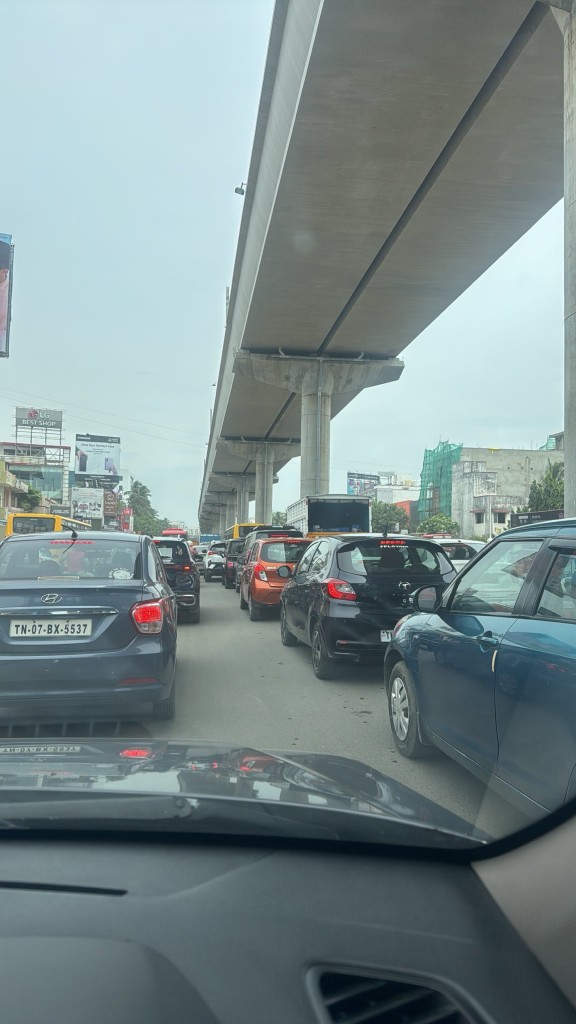
Completing more than 3,000 piles on an undeveloped site would itself be a major construction exercise. Completing them on an operating urban arterial road created an entirely different level of difficulty.
OMR carries continuous traffic throughout much of the day. It serves technology parks, residential neighbourhoods, hospitals, colleges, schools, retail centres and connections to several important east–west roads.
Construction teams could not simply close the entire corridor and work without restrictions. Work zones had to be created within limited road space while maintaining movement for buses, cars, two-wheelers, ambulances, commercial vehicles and pedestrians.
Every piling location required a coordinated sequence. Barricades had to be placed, traffic lanes realigned, machinery positioned, underground utilities identified or shifted, drilling carried out, reinforcement cages lowered and concrete poured. After the work was completed, the surrounding space had to be reorganised so that the next activity could begin without creating unsafe conflicts.
The challenge was particularly severe at major intersections such as Thoraipakkam and Sholinganallur. These junctions do not merely carry traffic along OMR. They also distribute vehicles towards Pallikaranai, Perumbakkam, East Coast Road, Medavakkam, Velachery and other fast-growing neighbourhoods.
At these locations, the Metro structures also had to be coordinated with existing or planned grade separators managed by state road agencies. This required careful integration of structural levels, pier positions, station access arrangements, road clearances and traffic diversions.
The work therefore involved more than building a railway viaduct. It required continuous coordination between Metro engineers, contractors, utility agencies, police, road authorities, local bodies and emergency-service providers.
Despite these constraints, the project team recorded its highest monthly piling output in October 2023, when 185 piles were completed. That figure indicates the scale of mobilisation required: multiple rigs, reinforcement teams, concrete-supply systems, testing personnel and traffic-management crews operating across several work fronts.
The hard-rock challenge at Sholinganallur
One of the most difficult engineering conditions arose around Sholinganallur, where construction teams encountered hard subsurface rock.
Piling equipment is generally selected after geotechnical investigations establish the expected soil profile. However, urban ground conditions can vary significantly over short distances. Layers of loose soil, clay, weathered rock and hard rock may occur within the same construction package.
When a piling rig reaches hard rock, drilling speed can fall sharply. Equipment and cutting tools face greater wear. Maintaining the required pile diameter and vertical alignment becomes more difficult. Excavated material must be removed safely, and the bore must remain stable until reinforcement and concrete are placed.
Such conditions can affect both construction schedules and machinery requirements. Specialised drilling tools and high-capacity rotary equipment may be required. Work may also generate additional noise and vibration, which must be managed in a developed urban area.
CMRL stated that advanced engineering techniques and specialised machinery were deployed to overcome the hard-rock conditions in the Sholinganallur area. The completion of the piling programme confirms that the subsurface obstacle was addressed without leaving unresolved foundation locations within the package.
This is an important achievement because foundations are sequential dependencies. A missing or delayed pile group can prevent construction of the corresponding pile cap, pier, pier cap and girder span. It can therefore interrupt the continuity of the viaduct even when adjoining sections are substantially complete.
Inside the Semmancheri casting yard
The second major milestone was achieved away from the main road, at Larsen & Toubro’s 35-acre precast casting yard in Semmancheri.
Casting yards function as industrial production facilities dedicated to manufacturing large structural components under controlled conditions. They include steel moulds, reinforcement-assembly zones, prestressing systems, concrete-batching facilities, curing arrangements, quality laboratories, storage areas and heavy lifting equipment.
Each U-girder passes through several stages before it can be transported to the alignment.
The mould must first be prepared and checked for dimensional accuracy. Prestressing strands and reinforcement are positioned according to structural drawings. Embedded items and drainage or cable provisions are installed. Concrete is then poured under controlled conditions and compacted to eliminate voids.
After the required strength is achieved, the prestressing system transfers compressive force into the girder. This allows the component to resist the tensile stresses that will arise when it carries its own weight, railway tracks, train loads and operational forces.
The finished component must then undergo dimensional checks, strength verification, surface inspection and other quality-control procedures before it is approved for dispatch.
The scale of the U-girders makes transportation another engineering operation. Movement from the casting yard to OMR generally requires specialised multi-axle trailers, route planning, temporary traffic control and coordination with overhead utilities and road authorities.
The girders must then be lifted by heavy cranes or specialised launching systems and positioned accurately on the pier caps. Since these operations occupy significant road space, they are often undertaken during carefully selected night-time windows.
The Semmancheri facility reached its peak monthly production in December 2024, when 40 U-girders were cast. Completing all 582 units means the package is no longer dependent on continuing girder manufacturing, although transportation, erection and related finishing work may continue at individual locations.
Corridor 3: the Purple Line from Madhavaram to SIPCOT
Corridor 3, commonly represented as the Purple Line in the Phase II network, extends from Madhavaram Milk Colony in North Chennai to Siruseri SIPCOT in the south.
CMRL currently describes the corridor as approximately 45.8 kilometres long. It includes about 26.7 kilometres of underground alignment and about 19.1 kilometres of elevated alignment. Official project information has referred to 50 stations under the Union Cabinet-approved configuration, while some updated maps and project documents use different station totals after design rationalisation. The alignment and final commissioned station count should therefore be taken from CMRL’s operational notifications when individual sections open.
The northern and central sections are predominantly underground because the alignment passes through dense neighbourhoods and constrained roads. The route then emerges towards the southern part of the city and continues as an elevated corridor along OMR.
The underground portion is among the most complex parts of Chennai Metro Phase II. It must pass beneath built-up neighbourhoods, railway infrastructure, utilities, road junctions and water-sensitive urban terrain.
The elevated OMR portion faces a different set of challenges. While tunnelling is not required, the alignment must be constructed in the median or constrained portions of a heavily trafficked road.
This combination of underground and elevated construction makes Corridor 3 a cross-section of almost every major engineering challenge associated with urban Metro construction.
The route is also planned to interact with other Metro corridors and transport systems. Sholinganallur is intended to function as a major interchange between Corridor 3 and Corridor 5, creating connections towards Medavakkam, Madipakkam, Alandur, Porur and Madhavaram.
Other interchange locations across Phase II are intended to connect the new corridors to the existing Metro, MRTS, suburban railway and major bus networks. The Union Cabinet’s project approval referred to multimodal integration at 21 locations across Phase II.
From proposal to construction: the history of Phase II
The need for a much larger Metro network became clear even before Chennai Metro Phase I was fully operational.
Phase I created two main corridors connecting Wimco Nagar and the airport, and Chennai Central with St Thomas Mount. These routes transformed travel along important parts of the city, but large areas of North Chennai, the western suburbs, OMR and the coastal-central belt remained outside direct Metro coverage.
The Tamil Nadu government announced the broad Phase II concept in 2016. The network was later expanded and revised through detailed project studies, environmental assessments, ridership modelling, engineering reviews and financing discussions.
CMRL’s comprehensive Phase II plan eventually evolved into three corridors:
- Corridor 3 from Madhavaram to SIPCOT;
- Corridor 4 from Lighthouse to Poonamallee Bypass; and
- Corridor 5 from Madhavaram to Sholinganallur.
The foundation stone for Phase II was laid in November 2020, and civil-construction contracts were progressively awarded for underground tunnels, elevated viaducts, stations, depots and system packages.
The project was also mentioned in the Union Budget for 2021–22 with an estimated completion cost of ₹63,246 crore.
A major institutional development occurred on 3 October 2024, when the Union Cabinet approved Chennai Metro Phase II as a centrally supported project covering 118.9 kilometres and 128 stations at the stated completion cost of ₹63,246 crore.
The Union government subsequently stated that it would finance almost 65 per cent of the estimated project cost, including the entire required loan component of ₹33,593 crore and ₹7,425 crore through equity and subordinate debt. The Tamil Nadu government was to finance the remaining 35 per cent.
The loan financing mobilised through bilateral and multilateral institutions would consequently be treated as borrowing by the Union government and passed to CMRL through the central budget. This arrangement was important because Phase II had initially been carried primarily as a state-sector project, placing a large financing responsibility on Tamil Nadu.
International financing and technical participation
Chennai Metro Phase II is supported through a complex financing structure involving Indian public funding and international development institutions.
The Japan International Cooperation Agency has had a long association with Chennai Metro, including support for Phase I and portions of Phase II.
JICA’s project evaluations describe Phase II as a response to urbanisation extending beyond Chennai’s historic centre and the resulting demand for high-capacity transport in peripheral areas. JICA financing has supported substantial portions of Corridors 3 and 5.
In March 2022, JICA signed a loan agreement providing 73 billion yen for the second tranche of the Chennai Metro Phase II project.
The Asian Development Bank is financing other Phase II components, including sections of Corridors 3 and 4. ADB project documents describe the broader objective as connecting central Chennai with major destinations in the southern and western parts of the metropolitan area.
Other international financial institutions have also participated in the wider funding framework.
Such financing is not limited to supplying capital. Development-bank-funded packages typically include environmental safeguards, social-impact assessments, resettlement frameworks, procurement standards, financial reporting and periodic monitoring.
This creates a governance structure in which progress must be evaluated against engineering, financial, environmental and social criteria.
The involvement of several funding agencies can make project coordination more complex, but it also distributes financing requirements and introduces multiple layers of technical and procedural oversight.
Why U-girders were selected
The use of U-girders is particularly relevant on a congested road such as OMR.
A conventional segmented viaduct may require numerous smaller elements to be transported, lifted, aligned, temporarily supported and joined. This can create repeated site operations over an extended period.
A precast U-girder consolidates much of the span into a larger single unit. The element is manufactured away from the road, transported after achieving the required strength and installed during a planned lifting operation.
The approach offers several potential advantages.
- It reduces the amount of concrete casting performed directly above or beside live traffic.
- Factory-style production allows tighter control over concrete mix, prestressing, dimensions and curing.
- Installation of a large integrated span can be faster than assembling many smaller segments at the same location.
- The U-shaped cross-section can reduce the need for separate parapet structures and provide a relatively compact structural profile.
The system also creates challenges. Each girder is extremely heavy and requires specialised transport and lifting equipment. Access routes must be surveyed. Crane positions must be engineered. Wind conditions, traffic blocks and lifting tolerances must be carefully managed.
Therefore, completing manufacture is a major milestone, but successful erection remains a separate high-risk activity governed by detailed method statements and safety procedures.
What comes after piling and girder casting?
The public often sees the appearance of elevated structures as evidence that a Metro project is almost complete. In reality, completing the visible concrete frame is only one stage in a long chain of activities.
After foundation piles are completed, pile caps, piers and pier caps must be constructed. U-girders must be transported and erected. Connections, bearings and structural interfaces must be inspected.
Stations require platforms, concourses, ticketing areas, stairways, lifts, escalators, emergency exits, fire-protection systems, ventilation, lighting, drainage, public-address systems, surveillance equipment and passenger-information displays.
Track systems must be installed and aligned to very tight tolerances. Power-supply equipment, overhead electrification and traction substations must be commissioned.
Modern Metro operations also depend on signalling and train-control systems. These systems regulate train separation, permitted speed, route setting and safe movement through stations and junctions.
Telecommunications systems connect trains, stations, the operations-control centre and emergency services. Automatic fare-collection equipment must be integrated with the wider Chennai Metro network.
Every subsystem undergoes individual testing before integrated testing can begin. Trains must then conduct trial runs under progressively more demanding operating conditions.
Independent safety assessments and statutory inspection by the Commissioner of Metro Railway Safety are required before passenger services can begin.
Consequently, the piling and casting milestone should be understood as completion of two major upstream construction activities, not completion of the entire Nehru Nagar–Sholinganallur railway.
The changing project timeline
The official timeline requires careful explanation.
When the Union Cabinet approved Phase II in October 2024, the government press release stated that the project was planned for completion by 2027.
CMRL’s project-status information, updated in March 2026, now states that Phase II is proposed to be completed by the end of 2028. Recent project reporting has also described staged commissioning, with elevated sections expected to open before several of the more complex underground sections.
The difference does not necessarily mean every corridor will open simultaneously in 2028. Large Metro networks are normally commissioned in operationally viable sections as civil construction, railway systems, train availability and regulatory approvals are completed.
For the OMR corridor, earlier targets have referred to portions of the elevated alignment being completed before the full underground Corridor 3 becomes operational.
However, exact passenger-opening dates should not be inferred solely from completion of civil milestones. CMRL must confirm trial-run schedules, safety inspection, station readiness and commercial-operation dates.
The most responsible formulation as of July 2026 is that Phase II is being implemented in stages and CMRL’s current overall project-status target extends to the end of 2028.
Expected impact on daily travel
The most immediate benefit expected from the OMR Metro is reduced dependence on road-based travel for a substantial share of daily journeys.
A commuter travelling from North Chennai to an OMR technology campus may currently need to combine a bus, suburban train, MRTS service, auto-rickshaw or company shuttle. Transfers can be unreliable, and road congestion affects the first and last parts of the journey.
A continuous Corridor 3 service could simplify such trips and make travel times more predictable.
The Metro is unlikely to eliminate OMR congestion by itself. Roads will continue to carry freight, buses, taxis, delivery vehicles, cars and two-wheelers. Population and employment growth may also generate new travel demand.
The more realistic benefit is that a high-capacity rail corridor will provide an alternative whose travel time is less affected by road conditions.
Predictability is especially important for employment corridors. A road journey that varies between 45 minutes and two hours imposes costs on employees and businesses. A reliable rail journey allows commuters to plan departure times, childcare, meetings and connections more effectively.
Metro access can also expand the labour catchment of OMR companies. Employers may be able to recruit from neighbourhoods that are currently considered too distant or difficult to reach.
Students, patients and residents will also benefit because OMR is not exclusively an employment corridor. It contains universities, schools, hospitals, government institutions, retail centres and rapidly expanding residential communities.
Interchange value at Sholinganallur
Sholinganallur is expected to become one of the most important transport nodes in South Chennai.
Corridor 3 runs north–south along OMR, while Corridor 5 is planned to connect Madhavaram and Sholinganallur through western and southern neighbourhoods.
Their intersection creates the possibility of direct transfers between OMR and areas such as Medavakkam, Madipakkam, Alandur, Porur, Koyambedu, Anna Nagar and Madhavaram, depending on the final operational configuration.
The interchange could reduce the need for commuters to travel through the city centre when their destination lies elsewhere in the metropolitan area.
For example, a passenger approaching from the southwest may be able to transfer at Sholinganallur instead of using multiple buses to enter the OMR corridor. Similarly, an OMR employee travelling towards western Chennai may use Corridor 5 without continuing north through central Chennai.
The effectiveness of the interchange will depend on station design. Transfers should involve short, accessible and weather-protected walking routes. Passenger movement must be supported by lifts, escalators, signs and adequate concourse capacity.
Road access outside the station will be equally important. Without organised bus bays, auto-rickshaw areas, pedestrian crossings and cycling facilities, congestion could simply concentrate around station entrances.
The Metro structure therefore represents only one part of the future transport hub. Street design and last-mile integration will determine how efficiently passengers can reach and leave the station.
The need for better last-mile connectivity
Metro stations cannot serve OMR effectively if passengers face unsafe or inconvenient journeys for the final one or two kilometres.
Many technology parks and residential developments are located away from the main road. Some internal roads lack continuous footpaths, safe crossings, shade or organised feeder services.
CMRL, the Metropolitan Transport Corporation, Greater Chennai Corporation, state highways agencies, employers and local communities will need to coordinate feeder connectivity.
Possible measures include frequent electric feeder buses, rationalised MTC routes, regulated shared mobility, bicycle parking, pedestrian-priority access and shuttle integration with major technology parks.
Large employers could reorganise company transportation around Metro stations rather than operating long-distance buses across the entire metropolitan region.
Station access must also account for persons with disabilities, older commuters, children and passengers carrying luggage. A station that is technically accessible inside but surrounded by broken footpaths and unsafe crossings does not provide complete accessibility.
OMR’s current pedestrian infrastructure has repeatedly attracted criticism. Foot overbridges and walkways have suffered from poor maintenance, inconvenient placement or limited accessibility in several locations.
Metro commissioning offers an opportunity to redesign the corridor around people rather than treating pedestrian facilities as secondary additions.
Construction inconvenience and public patience
The achievement has come after years of disruption for residents, businesses and road users.
Barricades reduced road capacity. Traffic diversions changed access to shops and residential streets. Dust, noise, night work and machinery movement affected communities along the alignment.
Pedestrians were frequently required to use narrowed temporary paths. Businesses located behind construction barricades faced reduced visibility and difficult customer access.
CMRL thanked residents, motorists and other stakeholders for their cooperation and patience during the piling and girder works.
That acknowledgement is important, but it should also be accompanied by rapid restoration of completed work zones.
Where major civil activities have ended, unnecessary barricades should be removed. Damaged road surfaces must be restored, drains cleared and safe pedestrian paths reinstated.
Construction agencies should continue publishing location-specific updates so that commuters know which sections are complete, where traffic restrictions remain and when road space will be returned.
Public acceptance of a large infrastructure project depends not only on its eventual benefit but also on how responsibly the construction period is managed.
Environmental significance
A Metro corridor is generally expected to support lower-emission urban travel by shifting a portion of passenger journeys from private vehicles to electrically powered mass transit.
The actual environmental benefit depends on ridership, electricity sources, feeder connectivity and the extent to which passengers shift from cars and two-wheelers rather than from existing buses.
Even so, high-capacity rail is an essential component of a city attempting to accommodate growth without expanding road traffic indefinitely.
The OMR corridor passes through environmentally sensitive parts of South Chennai’s wider landscape. The region is connected to wetlands, floodplains, canals and low-lying drainage systems.
Metro construction and station-area development must therefore maintain drainage pathways and avoid transferring flood risk to neighbouring areas.
Environmental safeguards should continue beyond the civil-construction period. Station designs must include effective stormwater management, waste handling, energy-efficient systems and heat-resilient pedestrian access.
Transit-oriented development should not be interpreted simply as permission for uncontrolled high-density construction. It should combine public transport, drainage capacity, pedestrian access, affordable mobility and responsible land use.
Economic and real-estate implications
Metro construction often influences land values and development interest around proposed stations.
OMR already has a mature commercial and residential market, but Metro access may change how individual locations are valued.
Areas within practical walking or feeder distance of stations may become more attractive to tenants, employers and investors. Older commercial properties may be redeveloped. Retail activity may concentrate near station entrances and interchange nodes.
However, Metro-related appreciation is not automatic or uniform. Properties separated from stations by unsafe roads, water channels or inaccessible compounds may receive less benefit than map distance suggests.
The quality of station access, availability of pedestrian routes, flood resilience, power and water infrastructure, and local road capacity will continue to influence development outcomes.
There is also a risk that rising land and rental values may displace lower-income households and small businesses. Urban planning must therefore consider affordable housing, vending zones and local economic participation.
The strongest long-term outcome would be compact, mixed-use neighbourhoods where residents can reach employment, education, healthcare and public transport without depending on private vehicles for every journey.
A milestone, not the finishing line
Completing all 3,066 piles and casting all 582 U-girders is a substantial accomplishment.
The numbers represent years of geotechnical work, structural engineering, concrete production, traffic management, quality control and coordination across a constrained urban corridor.
The milestone reduces uncertainty in two critical civil-construction areas. It confirms that the foundations required for the Nehru Nagar–Sholinganallur elevated section have been installed and that every U-girder required under the package has been manufactured.
The project must now convert those completed components into an operational railway.
Remaining girders must be erected where necessary. Stations must be completed. Tracks, power systems, signalling, telecommunications and safety systems must be installed and tested. Road surfaces and pedestrian spaces must be restored. Trains must undergo trial operations, and statutory safety approvals must be obtained.
For residents and commuters, the next meaningful indicators will be visible continuity of the viaduct, removal of barricades, station completion, track installation and the announcement of trial runs.
Corridor 3 has the potential to alter Chennai’s transport geography by connecting North Chennai, the central city and the OMR–Siruseri technology corridor through a single rapid-transit axis.
The July 2026 achievement does not mark the completion of that vision. It marks the point at which one of its most difficult elevated sections has moved decisively closer to becoming a railway.
MyOMR View
For OMR residents, this is the clearest civil-progress signal yet on the elevated Corridor 3 stretch through Perungudi, Thoraipakkam and Sholinganallur. Treat it as foundation-and-girder completion — not an opening date. Watch for erected spans, restored road space, station shells and CMRL trial-run notices before planning around passenger service.
Sources: Chennai Metro Rail Limited announcement (16 July 2026); package C3/EV-01 milestone documentation (3,066 piles / 582 U-girders); CMRL Phase II project-status information (March 2026); Union Cabinet Phase II approval materials (October 2024); JICA / ADB project financing references as cited in public project documents.