Latest update · 25 September 2026
Traffic police withdrew the new OMR U-turn arrangement within hours after the trial triggered two- to three-hour delays. U-turns at Geetham, Seevaram and WTC are open again — but the corridor still needs a smarter plan.
Greater Chennai Traffic Police withdrew an OMR U-turn trial at Geetham, Seevaram and WTC within hours after peak-hour queues of up to three kilometres and journeys taking two to three hours longer. The reversal fixes today's jam; corridor-level planning must follow.
The withdrawal of the new traffic arrangement within hours is not merely another story about an OMR traffic jam. It raises a larger question about how Chennai plans, tests and communicates traffic interventions on one of its busiest urban corridors.
Chennai · 25 September 2026 — Editorial by MyOMR Editorial Team

For thousands of people who use Old Mahabalipuram Road every day, Wednesday’s traffic disruption was more than an inconvenience. It was an illustration of how a seemingly small change in road management can produce consequences across an entire corridor.
The Greater Chennai Traffic Police introduced a trial traffic arrangement affecting U-turns near Geetham Restaurant, Seevaram/Srivaram and the World Trade Centre–Perungudi stretch. Certain motorists who would normally use these median openings were instead required to travel further before turning.
The intention was understandable: reduce conflicting vehicle movements, regulate U-turns and improve the overall flow of traffic.
What happened on the road was very different.
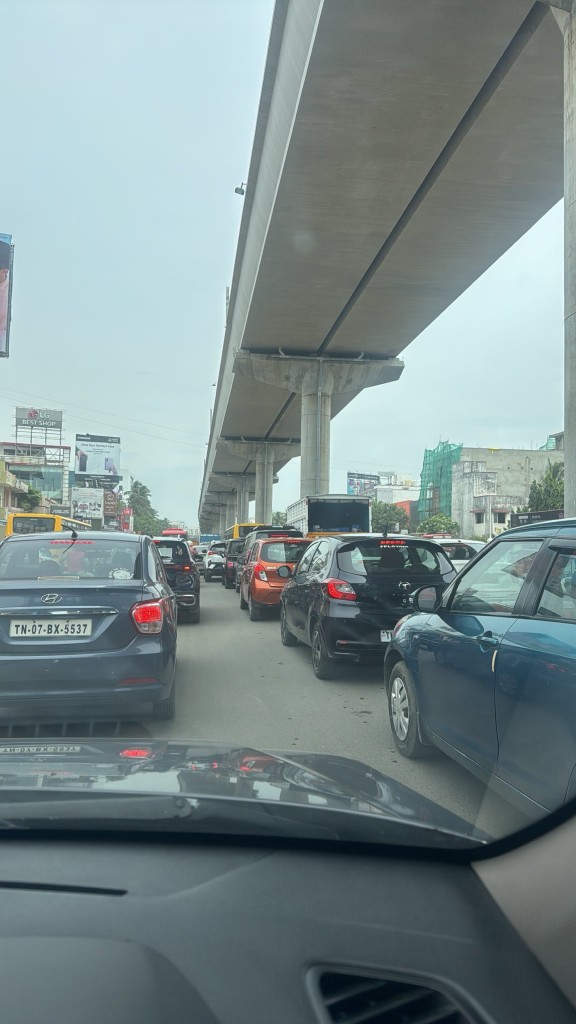
Long queues developed, journey times increased sharply and congestion spread across stretches of Rajiv Gandhi Salai. The New Indian Express reported queues extending for more than three kilometres at some locations, while commuters described journeys taking substantially longer than usual. Some motorists reportedly waited 15 to 20 minutes simply to negotiate a U-turn.
Within hours, the experiment was withdrawn. Barricades were removed and additional traffic personnel were deployed to restore normal movement.
That quick reversal solved the immediate problem.
But it should not end the discussion.
OMR is no longer just a road
Traffic planning on OMR cannot be approached as though Rajiv Gandhi Salai were simply a highway carrying vehicles from Point A to Point B.
The corridor has fundamentally changed.
Large IT campuses sit alongside residential communities, hospitals, schools, restaurants, commercial establishments and rapidly developing neighbourhoods. Roads from Perungudi, Thoraipakkam, Seevaram, Kandanchavadi, Pallikaranai and other areas continuously feed vehicles into and out of the main carriageway.
Every median opening therefore performs a function within a much larger network.
Close one U-turn and those vehicles do not disappear.
They travel to the next available turning point.
That additional movement increases the load there. Vehicles waiting to turn can begin occupying carriageway space. Through traffic slows. Queues extend backwards. Vehicles entering from service roads encounter the queue. Buses stop within or alongside it. Impatient motorists begin searching for alternatives.
A traffic intervention designed to remove one conflict point can therefore create another bottleneck a kilometre away.
This appears to be one of the central lessons from Wednesday’s experience.
78,000 vehicles leave little room for experimentation without preparation
The scale of OMR traffic makes this particularly important.
According to official figures reported by The New Indian Express, Rajiv Gandhi Salai handles approximately 78,000 vehicles during the morning and evening peak periods, with around 42,000 vehicles in one direction and 36,000 in the other.
At those volumes, even relatively minor changes in turning behaviour can have disproportionate consequences.
A U-turn cannot therefore be assessed only by asking whether it is safe or unsafe at that particular location.
Planners must also ask:
What happens to those vehicles after the U-turn is closed? Where will they turn instead? How many additional vehicles can the alternative U-turn accommodate? How far will its queue extend during peak hour? Will that queue interfere with through traffic? What happens to vehicles entering from service roads and side streets? What happens to buses, pedestrians and emergency vehicles? And critically, how much additional distance and time does the change impose on thousands of daily commuters?
Those questions require data.
Traffic engineering must examine the corridor, not just the junction
There is a broader planning principle here.
OMR needs corridor-level traffic management, rather than isolated junction-level interventions.
Traffic counts at individual intersections are useful, but they provide only part of the picture.
Origin-destination patterns matter. So do office shift timings, school traffic, bus stops, pedestrian crossings, service-road movements, signal cycles, apartment access points and the enormous concentration of vehicles entering and leaving IT campuses.
The effects also change by time of day.
A configuration that functions adequately at 11 a.m. may fail completely at 6 p.m.
This is why traffic interventions on a corridor such as OMR should ideally be supported by before-and-after measurements: average journey time, queue length, U-turn waiting time, traffic speed and the number of vehicles being redirected.
Without those measurements, success can become subjective.
A failed trial can still produce useful information
There is also a danger in drawing the wrong conclusion from Wednesday’s experience.
The lesson should not be that traffic experiments must never be attempted.
OMR clearly has traffic problems that require intervention. Unsafe U-turns, poorly managed median openings, bottlenecks and conflicting vehicle movements cannot simply be left untouched because changing them is difficult.
Trials are valuable precisely because real-world traffic behaviour cannot always be perfectly predicted.
The important question is how those trials are conducted.
A carefully designed pilot could initially be introduced outside the most demanding weekday peak periods. Traffic personnel could be positioned at every affected junction. Queue lengths and travel times could be measured in real time. Clear advance information could be provided to commuters.
If congestion begins exceeding predetermined limits, the trial can be modified or terminated before the corridor reaches gridlock.
In that sense, Wednesday’s experience itself has produced valuable data.
It has demonstrated how traffic redistributes when these particular turning movements are restricted.
That information should not be discarded merely because the experiment was withdrawn.
Communication is part of traffic management
There is another lesson.
Changing established traffic movements requires clear public communication.
For regular commuters, road behaviour is based heavily on routine. People know where they normally turn, which service road they use and approximately how long their journey takes.
When that pattern suddenly changes, thousands of drivers simultaneously have to make new decisions.
Advance communication through road signage, digital maps, traffic police social channels, IT companies, residents’ associations and local media can reduce some of that confusion.
On a corridor dominated by large workplaces, major employers can also play a role by informing employees before significant traffic trials begin.
Traffic engineering does not stop with barricades and road markings. Communication itself is part of traffic engineering.
The objective cannot simply be fewer U-turns
It is tempting to treat U-turn closures as a straightforward solution to congestion.
Fewer turning points can reduce vehicle conflicts and, under the right circumstances, improve traffic flow.
But the number of U-turns is not the metric that ultimately matters.
The real measure should be whether people can move through the corridor more safely and in less total time.
If closing three U-turns improves traffic at those three locations but adds substantial travel time elsewhere, the corridor as a whole has not necessarily improved.
Similarly, retaining every median opening simply because commuters are accustomed to it cannot be the answer either.
Each location must be evaluated on safety, capacity and its effect on the wider network.
OMR needs a larger mobility plan
Wednesday’s congestion ultimately points towards a problem larger than three U-turns.
OMR has undergone extraordinary urban growth. Its mobility system has struggled to evolve at the same pace.
Road engineering, service roads, public transport, pedestrian infrastructure, junction design, last-mile connectivity and eventually Metro connectivity must increasingly be considered as parts of the same system.
Traffic police can manage the vehicles already on the road.
But policing alone cannot solve a structural mobility problem created by tens of thousands of daily trips concentrated along one corridor.
That requires coordination between traffic police, the Greater Chennai Corporation, highways authorities, Chennai Unified Metropolitan Transport Authority and other agencies responsible for the city’s transport infrastructure.
The reversal should become data, not defeat
The decision to withdraw an arrangement that was causing serious congestion was necessary.
More importantly, authorities have indicated that the situation will be studied before further changes are considered.
That study matters.
The failed experiment has already revealed where traffic accumulated, how motorists responded and how quickly congestion propagated through the corridor. Properly analysed, those observations can help design a better intervention.
For OMR’s commuters, the immediate relief is that the new restrictions have been withdrawn.
For Chennai’s planners, however, the more important work begins now.
The question is no longer simply whether a particular U-turn should remain open or closed.
The question is how a road carrying tens of thousands of vehicles, serving one of Chennai’s largest employment corridors and surrounded by rapidly growing neighbourhoods can be managed as one interconnected mobility system.
Wednesday’s experiment did not provide that answer.
But it made the need for one considerably harder to ignore.
Background: The trial followed a Greater Chennai Traffic Police notice effective from 23 September 2026 restricting several U-turns on Rajiv Gandhi Salai. MyOMR reported first-day jams on 23 September; by 24 September the arrangement was rolled back after peak-hour gridlock. This page replaces our earlier day-one traffic alert with this editorial analysis.
Frequently asked questions
Was the OMR U-turn trial at Geetham, Seevaram and WTC withdrawn?
Yes. After severe congestion on the first day of the trial (24 September 2026), barricades were removed, U-turns were reopened and extra traffic personnel were deployed. Normal movement returned the same day.
Why did the U-turn restrictions cause such long delays?
Closing familiar median openings forced thousands of vehicles to the next available U-turn. Queues extended on Rajiv Gandhi Salai; commuters reported 15–20 minutes to negotiate a turn and overall journeys two to three hours longer, with queues over three kilometres in places per press reports.
How heavy is peak traffic on OMR?
Official figures cited by The New Indian Express put Rajiv Gandhi Salai at roughly 78,000 vehicles across morning and evening peaks — about 42,000 in one direction and 36,000 in the other — so small changes in turning behaviour can ripple across the corridor.
What should happen before the next traffic trial on OMR?
Planners should study origin–destination patterns, measure queue length and journey time, communicate in advance, and pilot outside the worst peak if possible — with clear limits to modify or stop the trial before gridlock spreads.
Sources: Greater Chennai Traffic Police public notice (September 2026); commuter and press reporting on the withdrawn trial, including queue and volume figures cited via The New Indian Express; MyOMR editorial desk. We will update if police announce a revised plan.