


Court update · 20 August 2026Wetland Watch
Tamil Nadu State Wetlands Authority told Madras High Court on 20 August 2026 that Pallikaranai Zone of Influence construction can be regulated, not blanket-banned. NCSCM's interim map proposes 0 metres along 30.14 km of the 77.85 km boundary. The NGT freeze is not lifted. Next listing is 7 September 2026.
Also on this corridor · Civic Watch
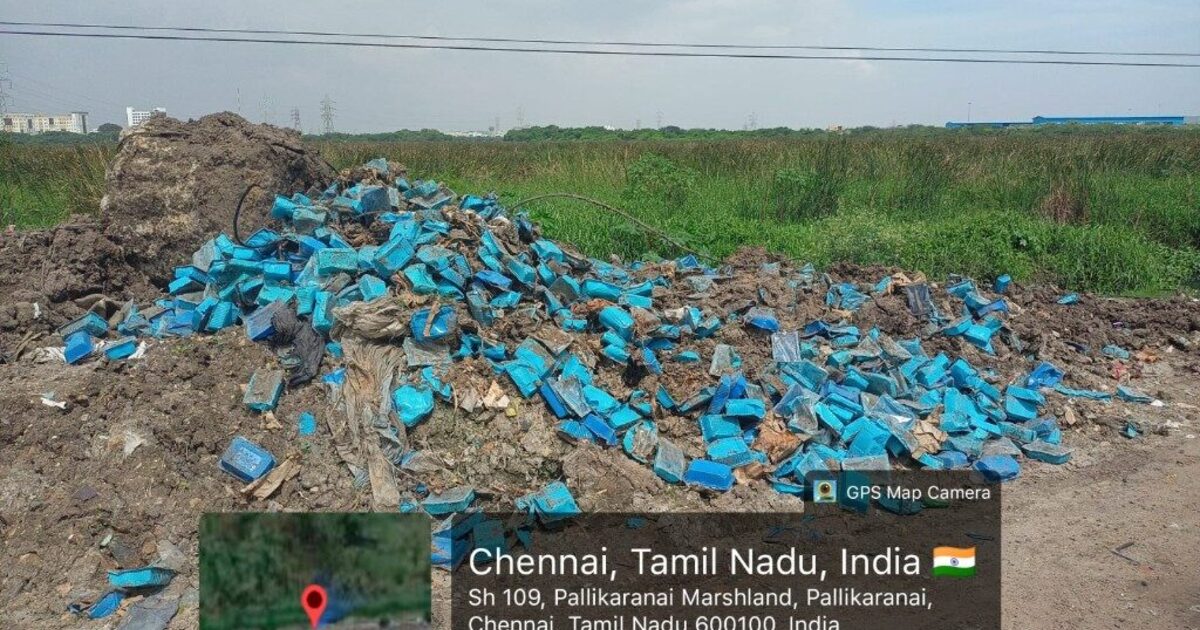
While the High Court weighs Pallikaranai’s Zone of Influence, residents on Corporation Road, Perungudi — the GCC street toward the dumpyard edge of the freeze belt — report 9 p.m.–midnight soil-haul lorries from the Sattva Chennai Knowledge City campus at Seevaram, including queues across apartment gates.
Read the 21 August night-lorry follow-up →
Earlier Corporation Road civic report (19 Aug)
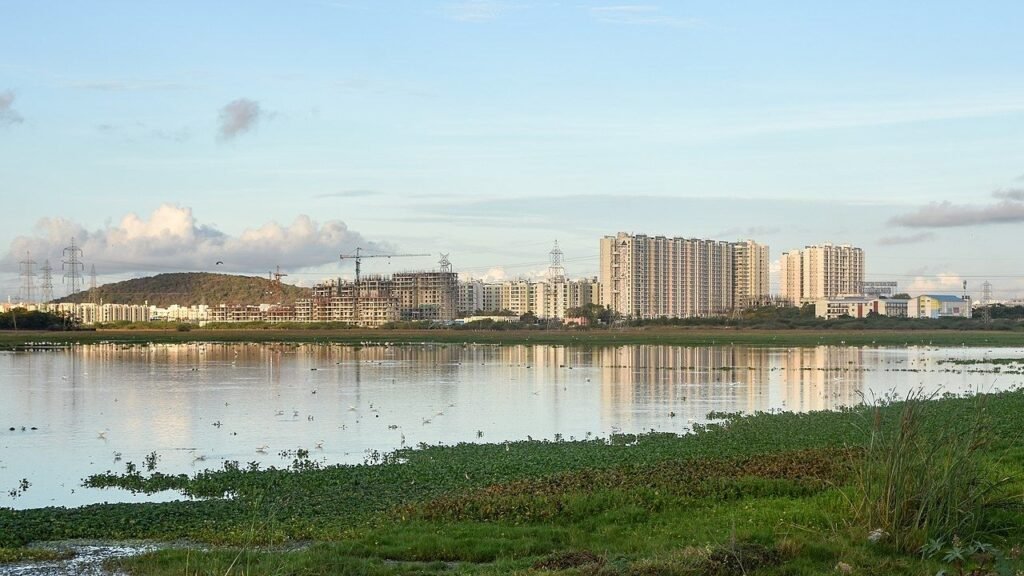
CHENNAI / OMR — The Tamil Nadu State Wetlands Authority (TNSWA) has told the Madras High Court that construction inside the Pallikaranai Marsh Zone of Influence (ZoI) need not face a blanket ban and can instead be regulated by site-specific ecological and hydrological conditions.
Chennai, 21 August 2026 — MyOMR is reporting this as a Wetland Watch court desk for Pallikaranai, Perumbakkam, Sholinganallur, Perungudi, Velachery, Thoraipakkam and Medavakkam. This is civic journalism, not legal advice and not a court order.
What the High Court was told on 20 August 2026
The First Division Bench of Chief Justice Sushrut Arvind Dharmadhikari and Justice G. Arul Murugan heard Additional Advocate General P.V. Balasubramaniam, assisted by advocate P. Veena Suresh, for the State. They placed a status report and a proposed interim ZoI prepared by the National Centre for Sustainable Coastal Management (NCSCM).
According to court reporting in The Hindu (21 August 2026), TNSWA told the Bench that construction of buildings in the ZoI encircling the 1,247.54-hectare Pallikaranai marshland can be regulated and need not necessarily be banned.
The judges took the status report on file. They granted two weeks to Senior Counsel P.S. Raman, appearing for CREDAI-Chennai, and to counsel for other parties, to study the report and make submissions. The Registry was directed to list the batch next on 7 September 2026. Our earlier desk note on that listing is here: Madras HC adjourns Pallikaranai cases to 7 September 2026.
The proposed interim Zone of Influence
NCSCM prepared the interim map at the State government’s request, using the Union Ministry of Environment, Forest and Climate Change Guidelines for Implementing the Wetlands (Conservation and Management) Rules, 2017. Those guidelines define a wetland’s ZoI as the area where developmental activities are likely to induce adverse changes in the structure and ecological functioning of the wetland ecosystem.
Pallikaranai sits in a densely built landscape with diffused drainage, gentle terrain and urban fabric against substantial stretches of the boundary wall. The State told the court that NCSCM therefore did not use a basin-based model meant for wetlands with a clear surface drainage system. Existing drainage pathways, low-lying areas, open landscape still hydrologically linked to the marsh, and satellite wetlands with direct hydrological or ecological connectivity were included in the proposed interim ZoI.
| Proposed interim ZoI width | Length of 77.85 km boundary | Share of boundary |
|---|---|---|
| 0 metres | 30.14 km | about 38.7% |
| 0–20 metres | 16.16 km | about 20.8% |
| 20–50 metres | 3.20 km | about 4.1% |
| 50–100 metres | 3.80 km | about 4.9% |
| Above 100 metres | 24.55 km | about 31.5% |
The report itself grouped the first two rows: about 46.30 km (59.5%) of the analysed boundary has a proposed interim ZoI width within 0–20 metres, while 24.55 km (31.5%) exceeds 100 metres.
“Thus, approximately 46.30 km (59.5%) of the analysed boundary has a proposed Interim ZoI width within 0-20 m, whereas approximately 24.55 km (31.5%) has a proposed Interim ZoI width exceeding 100 m. This substantial variation quantitatively demonstrates the heterogeneous character of the wetland-urban interface and supports a variable-width, site-specific approach rather than a uniform-distance ZoI.”
— NCSCM interim ZoI report, as quoted in The Hindu, 21 August 2026, from the 20 August Madras High Court record.Case details
- Forum
- Madras High Court, First Division Bench
- Coram
- Chief Justice Sushrut Arvind Dharmadhikari and Justice G. Arul Murugan
- Cause
- Batch of writ petitions, including CREDAI-Chennai chapter and other landowners / developers
- What is challenged
- NGT Southern Zone order dated 24 September 2025 restraining new approvals in a one-kilometre “zone of influence” around Pallikaranai Marsh (Ramsar Site No. 2481)
- Land in the 1-km belt
- About 8,584.44 acres (about 3,474 hectares), as stated in High Court reporting
- Marsh itself
- 1,247.54 hectares notified Ramsar wetland
- State counsel (20 Aug 2026)
- Additional Advocate General P.V. Balasubramaniam, assisted by P. Veena Suresh
- CREDAI counsel
- Senior Counsel P.S. Raman
- Last hearing
- 20 August 2026 — status report taken on file
- Next listing
- 7 September 2026
- NGT origin
- Suo motu proceedings after The New Indian Express report dated 30 June 2023 on a road across Perumbakkam marshland (OA 91 of 2023)
- NGT Southern Bench
- Judicial member Justice Pushpa Sathyanarayana and expert member Prashant Gargava
- CMDA follow-up
- Office Order No. 07/2025 (9 October 2025) operationalising the planning pause
Writ petition numbers for the CREDAI batch have not been uniformly published in the open news reports cited below. MyOMR will add docket numbers when an uploaded High Court order states them.
Quoted record: NGT order and High Court observations
There is still no final Madras High Court judgment disposing of this batch. What exists on the public record, via contemporaneous court reporting, is an NGT written order, later High Court oral observations, and the 20 August status report.
NGT Southern Zone, 24 September 2025
The tribunal directed that planning permission and construction approval around Pallikaranai wait until the Integrated Management Plan is finalised and TNSWA scientifically determines the zone of influence. The New Indian Express (25 September 2025) quoted this line from the order:
“Even assuming the site is patta land, it lies less than 150m from the Ramsar boundary and falls within the zone of influence of the marsh.”
— NGT Southern Zone order dated 24 September 2025, as quoted by The New Indian Express, 25 September 2025.The Hindu (26 September 2025) reported the operative restraint in these terms: until the IMP is finalised and the zone of influence is officially notified, no new planning permissions, approvals or sanctions should be granted for any project that may alter the character of Pallikaranai Marshland or its adjoining hydrological systems. That is the freeze later administered by CMDA and challenged before the High Court. Background for patta holders: Pallikaranai Ramsar freeze explained.
Madras High Court, 4 August 2026 (oral observations)
This is not a signed interim judgment uploaded as a PDF in the sources below. The Hindu reported the Bench’s oral inclination:
The judges said they were inclined to set aside the blanket ban imposed by the NGT even before determination of the zone of influence around the wetland. They did not want the lifting of that ban by the court to be mistaken as a licence for indiscriminate constructions around the marshland. They asked the State for suggestions on where construction could be permitted and where it should remain banned until the final ZoI is determined.
— Paraphrase of First Division Bench oral observations on 4 August 2026, as reported by The Hindu, “Madras High Court adjourns Pallikaranai construction ban cases to August 20.”Madras High Court, 20 August 2026 (status report, not a final order)
The 20 August listing is the State’s answer to that direction: an NCSCM interim map plus TNSWA’s position that ZoI activity can be regulated rather than banned across the board. The Bench did not, on that date, pronounce a final judgment, did not notify a new statutory ZoI, and did not tell CMDA to start issuing permissions.
Why a kilometre circle was never the last scientific word
In July 2026 TNSWA member secretary Srinivas R. Reddy told the same High Court that a zone of influence is “not a fixed or uniform area” and that the 1-km band in the pre-Ramsar draft Integrated Management Plan prepared by Care Earth Trust was “indicative in nature.” The authority quoted the draft plan’s own caution that both the buffer model and the directional model had been “rendered fallacious in view of the intense built-up area abutting the marsh.” Full July briefing: no fixed 1-km buffer.
CMDA told the court in July 2026: “The consideration of 1 km as ‘zone of Influence’ without completion of the due statutory procedures may not be correct.” CREDAI-Chennai has argued that Ramsar listing does not by itself create a one-kilometre prohibited zone, and that a uniform ban freezes already urban land without acquisition. Wetland advocates and the original NGT record stress the opposite risk: feeder canals, sheet flow and satellite wetlands are how Pallikaranai still functions as Chennai’s flood sponge. See why the marsh is flood infrastructure and why OMR wetlands are everyone’s responsibility.
How we got here
- 30 June 2023 The New Indian Express reports a road being laid across Perumbakkam marshland. NGT Southern Zone takes suo motu cognisance (OA 91 of 2023).
- 8 April 2022 Pallikaranai Marsh Reserve Forest is designated Ramsar Site No. 2481 (1,247.54 ha). NCSCM later takes up a revised IMP under the Wetlands Rules, 2017. Resident guide: Pallikaranai Marsh Ramsar explainer.
- 24 September 2025 NGT restrains new approvals until the IMP and scientific ZoI are ready. Reporting treats a one-kilometre belt as the interim influence area.
- 9 October 2025 CMDA Office Order No. 07/2025 pauses planning permissions in the Ramsar boundary and reported 1-km influence area.
- March–July 2026 CREDAI-Chennai challenges the NGT restriction in the High Court. TNSWA tells the Bench there is no fixed 1-km buffer.
- 4 August 2026 First Division Bench records an oral inclination against a blanket ban imposed before ZoI mapping, and asks the State for an interim line that still protects inflows.
- 20 August 2026 TNSWA / NCSCM place the variable-width interim ZoI on record. Construction in the ZoI, they say, can be regulated rather than banned. Next date: 7 September 2026.
What this means on OMR
The scientific point is now on the court record in numbers, not slogans. If 30.14 km of the marsh edge has a proposed interim ZoI of zero metres, a compass circle of one kilometre around every bund cannot be the only planning rule. If 24.55 km still needs more than 100 metres — and some stretches will need more once hydrology is fully mapped — a political demand to “open everything” is equally unscientific.
Hydrology, not distance, remains the test. A plot that looks “outside” a 20-metre strip can still sit on a drain, a filled channel or a satellite wetland that feeds Pallikaranai. That is why TNSWA and NCSCM say regulation must follow drainage patterns, flood pathways, ecological sensitivity and long-term protection of the marsh — not a single radius, and not a free-for-all either.
Related project-level dispute on the same wetland edge: Brigade Morgan Heights environmental clearance revocation.
What residents, buyers and builders should do now
- 1. Record the parcel identity. Note revenue village, survey number and subdivision from patta, chitta or FMB sketch for Pallikaranai, Perumbakkam, Sholinganallur, Perungudi, Velachery, Thoraipakkam or Medavakkam.
- 2. Check the current freeze, not the proposed map. Confirm whether CMDA Office Order No. 07/2025 or a later written order still holds the parcel. The NCSCM interim ZoI is a proposal before the High Court, not a building licence.
- 3. Screen hydrology, not only distance. Ask whether the plot sits on a drain, feeder canal, low-lying flood path or satellite wetland linked to Pallikaranai Marsh. Distance from the bund is not the only test.
- 4. Get a written planning reply. Seek written status from CMDA or the local body before purchase, construction or loan disbursement. Oral claims that a survey number is cleared are not enough.
- 5. Track the 7 September 2026 listing. Follow the Madras High Court First Division Bench listing and any uploaded order. Until then, treat the NGT restriction as continuing.
Buyers along Perumbakkam, Sholinganallur, Pallikaranai, Velachery and the inner OMR belt should still ask for current planning permission, RERA status, wetland caveats and any court disclosure before paying a booking amount. A proposed 0-metre stretch on a map does not mean your survey number is cleared.
Frequently asked questions
Has the Madras High Court lifted the Pallikaranai construction ban?
No. On 20 August 2026 the First Division Bench took the Tamil Nadu State Wetlands Authority status report on file and posted the batch to 7 September 2026. That is not a judgment lifting the National Green Tribunal restriction or the CMDA planning freeze.
Did TNSWA say construction is allowed everywhere around Pallikaranai Marsh?
No. The authority told the Madras High Court that construction in the Zone of Influence can be regulated and need not face a blanket ban. Regulation must still follow drainage, flood pathways, hydrology and ecological sensitivity. The notified 1,247.54-hectare Ramsar wetland itself remains protected.
What is the proposed interim Zone of Influence around Pallikaranai?
NCSCM told the court the wetland boundary is 77.85 km. Proposed interim ZoI width: 0 m on 30.14 km; 0–20 m on 16.16 km; 20–50 m on 3.20 km; 50–100 m on 3.80 km; and above 100 m on 24.55 km. About 59.5% of the boundary is 0–20 m; 31.5% exceeds 100 m.
What is the Madras High Court case on Pallikaranai construction?
A batch of writ petitions, including CREDAI-Chennai, challenges the NGT Southern Zone order of 24 September 2025 that halted new approvals in a one-kilometre zone of influence around Pallikaranai Marsh, a Ramsar site. The First Division Bench of Chief Justice Sushrut Arvind Dharmadhikari and Justice G. Arul Murugan is hearing the matter.
What did the NGT order on 24 September 2025?
The Southern Bench of Justice Pushpa Sathyanarayana and expert member Prashant Gargava directed that no new planning permissions be granted around Pallikaranai until the Integrated Management Plan is finalised and the zone of influence is scientifically determined. The case began as suo motu proceedings after a 30 June 2023 report on a road across Perumbakkam marshland (OA 91 of 2023).
What should OMR property owners do after the 20 August 2026 hearing?
Treat the CMDA freeze as continuing until a published court or government order says otherwise. Note village and survey number, check written planning status, compare the plot with Ramsar and drainage maps, and wait for the 7 September 2026 listing. This is not legal advice.
Related MyOMR coverage
- Night lorries on Corporation Road, Perungudi — soil haul next to the freeze zone
- Madras HC adjourns Pallikaranai NGT cases to 7 September 2026
- Wetland Authority: no fixed 1-km buffer (July 2026)
- Pallikaranai Ramsar freeze — what the 1-km approval ban means
- Pallikaranai as Chennai flood infrastructure
- OMR wetlands are everyone’s responsibility
- Pallikaranai Ramsar complete guide for OMR residents
- Pallikaranai Marsh — Ramsar site guide
- Sholinganallur neighbourhood guide · Perumbakkam · Perungudi
Primary court reporting cited: The Hindu, 21 August 2026 (20 August hearing, NCSCM interim ZoI figures); The Hindu, 4 August 2026 oral observations; The Hindu, 15 July 2026; The New Indian Express, 11 July 2026; The New Indian Express, 25 September 2025 (NGT order quote); The Hindu, 26 September 2025; The New Indian Express, 4 March 2026 (CREDAI petition); NGT record in OA 91 of 2023, TNSWA report at the Green Tribunal public file.
Disclaimer: Civic journalism for OMR readers. Not a certified copy of any judgment, not legal advice, and not a finding on any survey number. Oral observations are not a substitute for an uploaded order. The legal position can change on 7 September 2026 or earlier. Verify a specific plot with CMDA, the local body and independent counsel.