
Civic evidence · 14 November 2026Wetland Watch
On 14 November 2026 MyOMR documented two dumps on the Pallikaranai marsh link road at GPS 12.949183, 80.21834. The same week Perungudi RWAs asked GCC to speed biomining at the adjoining dumpyard. Tamil Nadu Chief Minister C. Joseph Vijay inspected Chetpet Bio-CNG in July 2026; a marsh-and-dumpyard inspection is still pending.
CHENNAI / PALLIKARANAI — Despite repeated warnings, official assurances and environmental protection measures, construction debris and mixed waste continue to appear along the roads bordering Pallikaranai Marshland. Fresh photographs from 14 November 2026 record two separate dumping spots on the marsh link road and raise urgent questions about enforcement, accountability and the future of one of Chennai’s most important ecological assets.
Chennai, 14 November 2026 — MyOMR Wetland Watch. This is civic documentation, not a finding of guilt against any named company, contractor or individual.
Two dumpings, one marsh edge
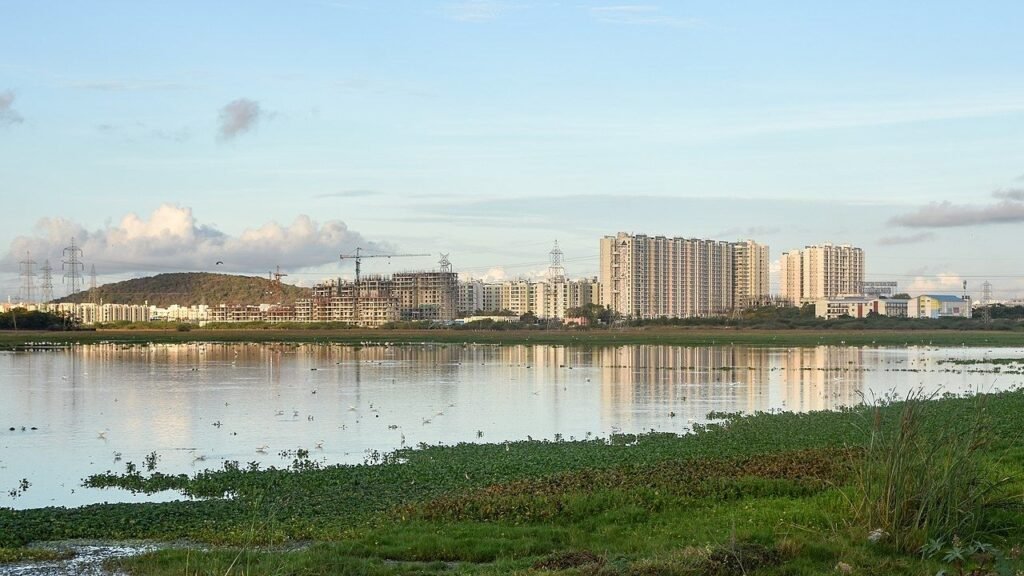
Pallikaranai Marsh is a Ramsar wetland. The road that hugs it is not a private dump. On 14 November 2026 MyOMR recorded two distinct spots, hours apart, on the marsh-border network.
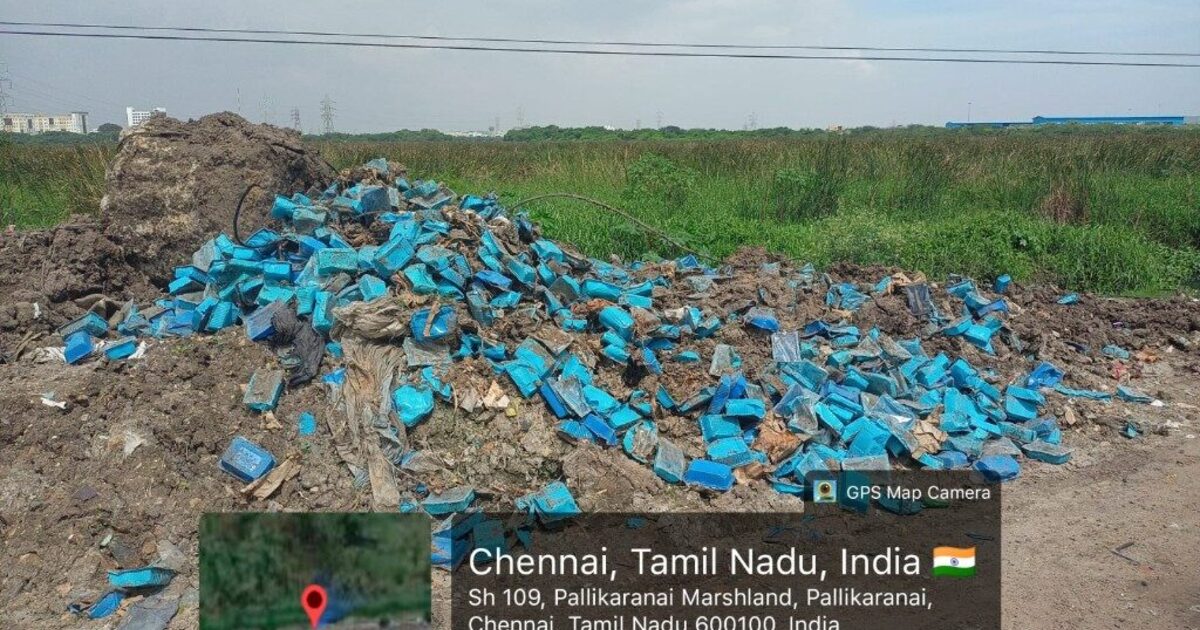
Spot 1 — commercial blue packaging pile on SH-109
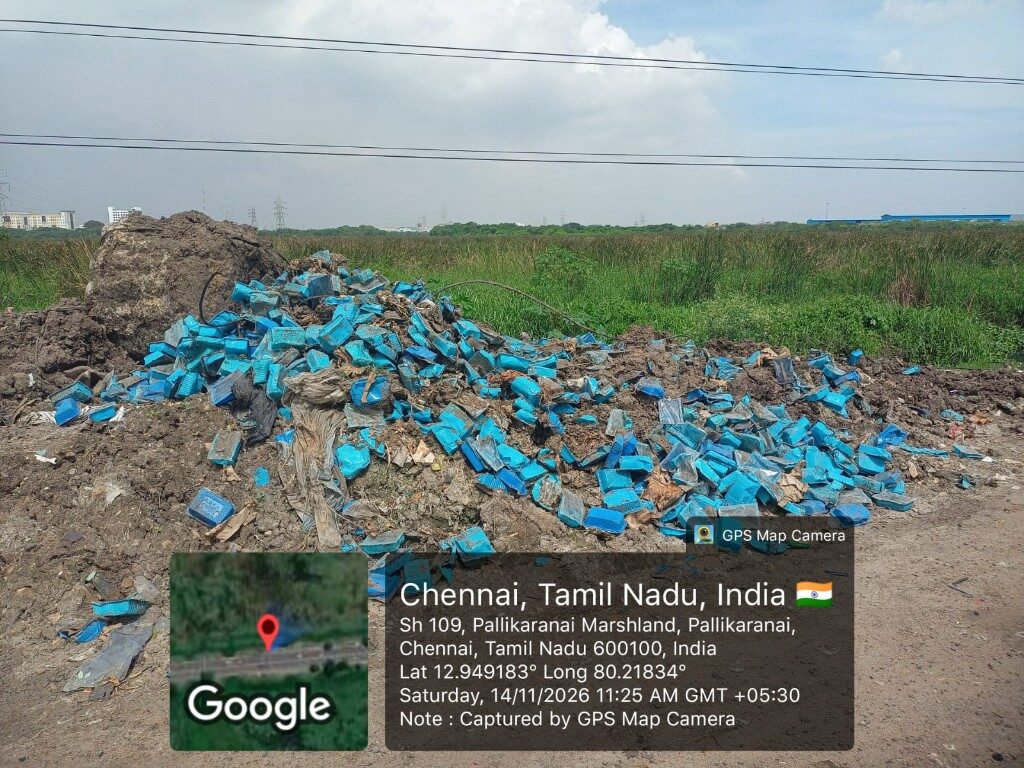
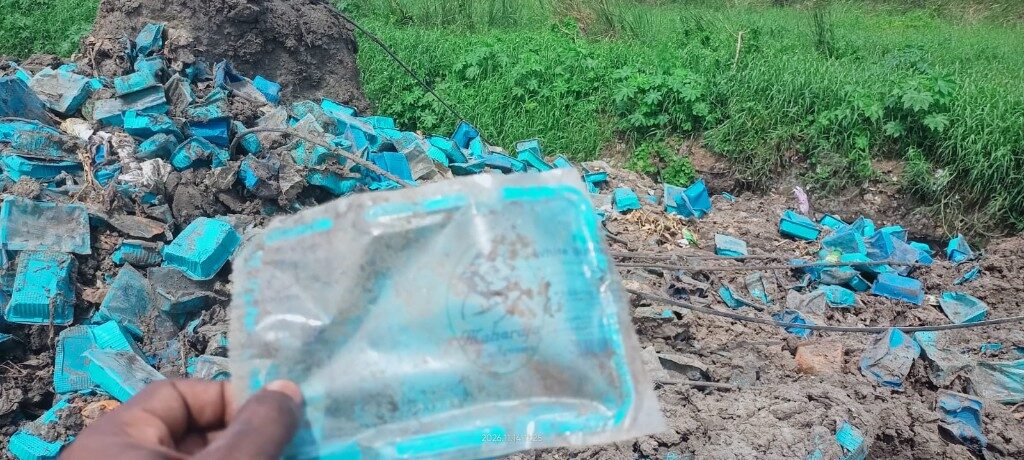
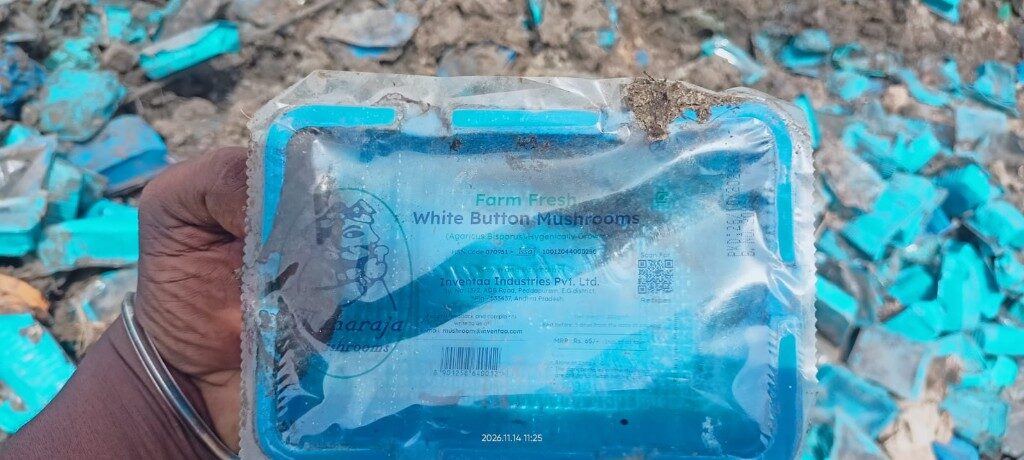
Geotagged at 12.949183° N, 80.21834° E on SH-109, Pallikaranai Marshland, Pallikaranai, Chennai 600100 (captured 14 November 2026, 11:25 IST). A mound of identical blue food trays sits on marsh-side earth. Close-ups show commercial mushroom packaging, including farm-fresh white button mushroom trays. This is a concentrated commercial-packaging dump, not scattered household litter.
Spot 2 — mixed and construction debris being cleared
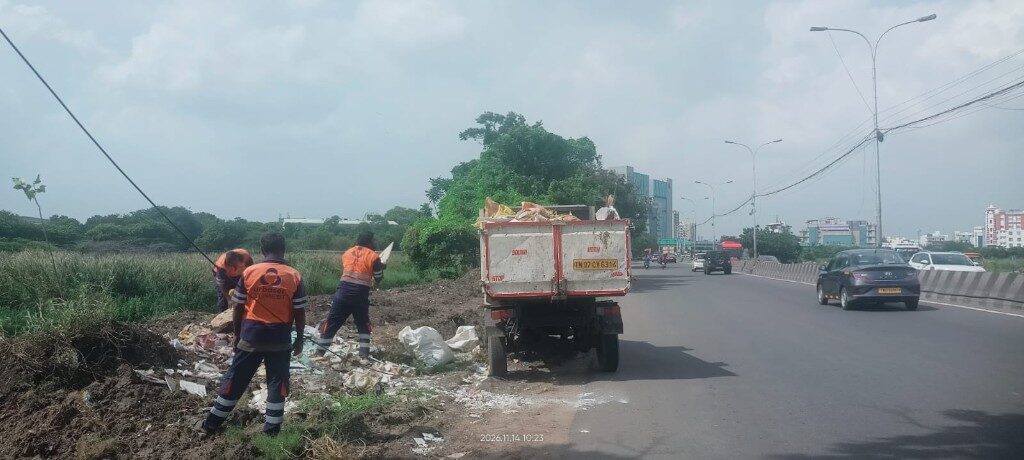
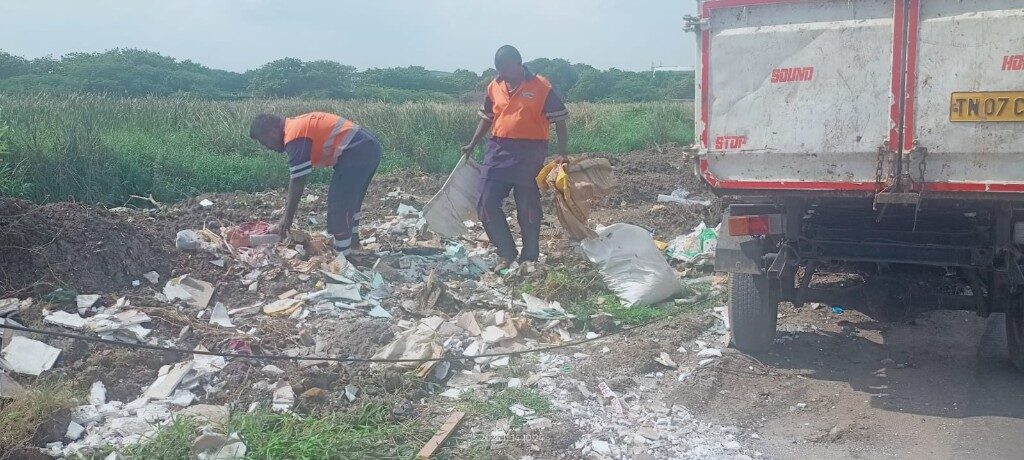
On a marsh-border carriageway the same morning, Greater Chennai Corporation sanitation workers in high-visibility gear were clearing mixed waste: broken masonry, plastic, bags and rubble. A Corporation truck was on site around 10:23–10:24 IST. The workers are managing the consequence. The unanswered question is who delivered the material, and what stops the next load.
A recurring problem that clearance alone cannot solve
Waste-clearance crews are often left managing disposal practices they do not control. Removing illegally discarded debris is labour-intensive, needs vehicles and personnel, and diverts capacity from routine sanitation. Construction rubble cannot be handled like household waste. The photographs also show workers on uneven ground among sharp fragments, which raises worker-safety questions.
The sanitation workers deserve recognition. Their work addresses an immediate public-health problem. It cannot substitute for enforcement against the original offenders.
A successful waste-management system should prevent illegal dumping rather than repeatedly pay to clear its consequences.
Why Pallikaranai is more than a vacant roadside
Pallikaranai Marsh Reserve Forest was designated a Wetland of International Importance under the Ramsar Convention in April 2022 as Ramsar Site 2481. The notified wetland covers about 1,247.54 hectares.
The marsh is part of South Chennai’s drainage system. It receives water from interconnected wetlands and helps regulate stormwater towards the coast. It supports birdlife, aquatic species and vegetation, and it is flood infrastructure for OMR, Perungudi, Pallikaranai, Velachery, Thoraipakkam, Medavakkam, Perumbakkam and Sholinganallur.
Discarded material can obstruct drains, alter surface-water movement, introduce pollutants and damage vegetation. Where debris fills low-lying land, it can gradually rewrite wetland terrain. The precise impact of these two spots needs scientific inspection. The potential consequences are serious enough to require it now.
From illegal dumping to gradual wetland degradation
One load looks small against 1,247 hectares. Repeated loads do not. Roadside deposits can raise ground levels, block natural drainage and invite the next dump or unauthorised occupation. That risk sits inside a landscape where wetland boundaries, development permissions, drainage pathways and conservation duties are already before courts and the public.
Authorities must determine whether the material sits entirely in the road margin, inside protected wetland land, inside a proposed influence zone, or across jurisdictions. That distinction matters for legal tools. It does not reduce the duty to stop unauthorised dumping.
The warning was already raised in Chennai Corporation
This is not a newly discovered concern. On 30 July 2025, Greater Chennai Corporation Mayor R. Priya publicly assured action against illegal construction-debris dumping and encroachments around Pallikaranai after Perungudi Zone ward committee chairperson S. V. Ravichandran raised the issue in Council. The Mayor indicated coordination with the Forest and Highways Departments, debris removal, and CCTV to prevent further violations (DT Next).
More than a year later, the 14 November 2026 photographs make it necessary to ask whether those preventive measures exist at these two spots. Were cameras installed? Do they work? Have offenders been identified? Have penalties been imposed? Are waste-generating contractors being traced? The public deserves a documented answer.
Political attention increased in 2026. Roadside enforcement is still the test
- 30 July 2025 Mayor R. Priya and S. V. Ravichandran — Council discussion on illegal debris dumping and encroachment; CCTV and clearance proposed.
- 24 September 2025 NGT Southern Zone restricts planning and construction approvals in and around the marsh pending the integrated management plan and zone of influence (The New Indian Express reporting).
- 19 July 2026 Dr. Anbumani Ramadoss and Sowmiya Anbumani join a Pasumai Thaayagam campaign seeking stronger protection and notification of the marsh (PTI).
- 30 August 2026 Awareness rally demanding notification and protection; criticism of the conservation record (The Times of India).
- 6 September 2026 Sowmiya Anbumani inspects Neithal restoration works and warns that a proposed concrete wall and walkway could obstruct natural water movement (DT Next).
- 24 September 2026 Chennai Wetlands Action Collective and Oorvani Foundation associated with a Citizen’s Charter for the Pallikaranai watershed (DT Next).
- 13 October 2026 Reporting on a proposed interim zone of influence described safeguards against dumping construction debris, obstructing drainage and discharging untreated wastewater. The boundary remained provisional (The New Indian Express).
- 5 November 2026 Dr. Anbumani Ramadoss alleged a real-estate-related conspiracy involving Pallikaranai land and urged the Chief Minister to intervene in road works. These are political allegations, not established findings (DT Next).
- 14 November 2026 MyOMR photographs of Spot 1 packaging dump (GPS) and Spot 2 mixed-debris clearance.
PMK leader Dr. Anbumani Ramadoss has repeatedly called for protection and formal demarcation, warning that degradation can compromise Chennai’s flood resilience. Environmental groups including Pasumai Thaayagam, Poovulagin Nanbargal, Chennai Wetlands Action Collective and Oorvani Foundation have sought basin-level planning and stronger coordination. Policy speeches do not replace what happens on the roadside after working hours.
A new government, the same marsh-and-dump landscape
Tamil Nadu’s 2026 Assembly results, declared on 4 May, changed the government. On the OMR corridor, TVK won Sholinganallur, Velachery and Thiruporur. Chief Minister C. Joseph Vijay took office with a mandate that included urban cleanliness and scientific waste handling.
That mandate is now tested where South Chennai actually puts its waste: the Perungudi dumpyard pressed against Pallikaranai Marsh, and the marsh-link roads where fresh debris still appears after working hours.
On 20 July 2026 the Chief Minister inspected the Chetpet Bio-CNG plant, a Greater Chennai Corporation PPP facility. He directed that Chennai’s reported 6,150 tonnes of daily municipal waste be segregated, that biodegradable waste become biogas and manure, and that non-biodegradable fractions be used in roads and as refuse-derived fuel. He asked officials to replicate the model across Tamil Nadu (The Hindu; The New Indian Express).
A Chetpet inspection is a processing-plant visit. It is not yet a walk along Pallikaranai’s bund, the Perungudi mounds, or SH-109 where today’s photographs were taken. Five days after Chetpet, MyOMR published an editorial arguing that the next inspection must be an integrated Perungudi–Pallikaranai ground visit — not a gate-level photo stop. See Why the Chief Minister must visit the Perungudi dumpyard and Pallikaranai Marsh now.
As of 14 November 2026, MyOMR has not seen a published Chief Minister inspection of either the dumpyard or the marsh edge. The 14 November dumps, two days after a resident representation on biomining delay, keep that request current.
Perungudi dumpyard: biomining continues, fresh waste has not stopped
The dumpyard and the marsh are one hydrology. Leachate, smoke, windblown plastic and raised ground at Perungudi do not respect a fence line. The 4 June 2026 dumpyard fire already showed how a waste site beside the Ramsar wetland becomes a South Chennai air and health emergency.
On 26 October 2026 GCC told The New Indian Express that at Perungudi 29.28 lakh cubic metres of legacy waste had been cleared and 96 acres reclaimed. Phase II had processed 1.08 lakh MT of 5.50 lakh MT (about 20%) as of 25 October, with a March 2027 target. The revised budget also listed extra biomining of 16.50 lakh MT at about Rs 158.93 crore. Kodungaiyur was reported further ahead on percentage of legacy waste cleared.
On 12 November 2026 — two days before the SH-109 photographs — a collective of Perungudi-area resident welfare associations wrote to Additional Chief Secretary (MAWS) Gagandeep Singh Bedi and GCC Commissioner G.S. Sameeran asking GCC to speed biomining across the dumpyard, stop dumping that affects Pallikaranai Marsh, and remove accumulated waste. They said biomining began in October 2021 with a 2024 completion target that has been missed. Federation of Thoraipakkam Residents Welfare Associations president A. Francis told DT Next that work was progressing at a snail’s pace and that residents face disease, mosquitoes, groundwater risk and stench in the rains. Associations in Anand Nagar, Vinayaga Nagar, MCN Nagar and Thoraipakkam Industrial Estate were named in that reporting. Residents also said the height of fresh waste had risen above 50 feet.
A senior GCC official, quoted in the same report, said 110 acres had been reclaimed in two phases, that 32 acres of ongoing work were expected by May 2027, that a government order covered remaining reclamation from March 2027, and that a 100-tonne windrow composting plant was being set up at Perungudi so that, after legacy waste is cleared, fresh waste could be processed. Standing Committee on Health chairperson G. Shanthakumari said she had sought a groundwater-contamination report and CCTV on inbound and outbound vehicles.
Official acreage and resident acreage do not match. That is itself a reason for a public dashboard: original waste, waste processed, waste remaining, land reclaimed, land restored, and whether mixed fresh waste is still arriving while biomining continues. India’s Solid Waste Management Rules, 2026, in force from 1 April 2026, treat landfills as residual-only sites and require time-bound legacy-dump remediation. Perungudi is the Chennai test of those rules.
Roadside packaging trays and construction debris on SH-109 are not the dumpyard. They are the same failure mode: waste leaving a lawful chain and landing on the marsh edge.
The public request: the Chief Minister should walk this landscape
The request is no longer only an editorial. It now sits on a stack of 2026 facts:
- a new government that has already chosen waste processing as a visible Chief Minister file (Chetpet, 20 July);
- a July MyOMR call for an integrated Perungudi–Pallikaranai inspection with maps, pollution sampling and deadlines;
- NGT and High Court scrutiny of the marsh zone of influence;
- Anbumani Ramadoss, on 5 November, publicly urging the Chief Minister to intervene in Pallikaranai road works (a political allegation, not a court finding);
- Perungudi RWAs, on 12 November, asking the municipal administration to finish biomining and stop dumping that hits the marsh;
- MyOMR photographs, on 14 November, of two active dump spots on the marsh link road, including a GCC clearance at Spot 2.
What residents are asking for is not a ceremonial halt at the dumpyard gate. It is an on-ground Chief Ministerial inspection covering:
- legacy mounds, biomining packages and any fresh waste still arriving at Perungudi;
- leachate, drain mouths and the marsh water-spread;
- SH-109 and other marsh-border roads used for illegal debris;
- CCTV, weighbridge and contractor records;
- a single public map of Ramsar land, reserve forest, dumpyard, proposed influence zone and flood pathways.
A visit after the next flood would only document damage that is already visible in photographs. A visit now would match the government’s own waste-science message with the place where Chennai’s waste and Chennai’s wetland actually meet.
What the authorities must investigate
A coordinated response should involve Greater Chennai Corporation, Tamil Nadu Pollution Control Board, Tamil Nadu Forest Department, Tamil Nadu State Wetlands Authority, Conservation Authority of Pallikaranai Marshland, the Highways / road-owning authority, Water Resources Department, CMDA where land-use applies, Chennai and Chengalpattu Collectors where survey lines cross, jurisdictional police, and — through proper procedure — the National Green Tribunal, Southern Zone.
Inspect both spots. Geotag them. Check CCTV, vehicle movements, contractor disposal records and previous complaints. Identify whether waste came from construction sites, commercial premises, municipal operations or other sources. Apply the Solid Waste Management Rules, Construction and Demolition Waste Management Rules and wetland law where the facts fit. The NGT has already intervened on dumping, encroachments and Pallikaranai ecology. This evidence belongs in that compliance picture.
Measurable demands (editorial accountability clock, not a statutory deadline)
| When | Action | Who |
|---|---|---|
| 48 hours | Joint site inspection, geotagging and photographic record of both spots | GCC, TNPCB, Forest Department |
| 7 days | Map dumping hotspots; assess CCTV and vehicle logs | GCC, police, road authority |
| 15 days | Publish a waste-clearance and enforcement status note | GCC, TNPCB |
| 30 days | Surveillance and targeted patrols at repeat hotspots | GCC, police, road authority |
| 30 days | Drainage and ecological impact assessment | TNSWA, Forest Department, WRD |
| Monthly | Publish complaints, repeat incidents, penalties and corrections | State-designated nodal agency |
| This monsoon window | Chief Minister on-ground inspection of Perungudi dumpyard, Pallikaranai marsh edge and SH-109 dump spots, with a public biomining dashboard | Chief Minister’s Office, MAWS, GCC |
How to complain
- Greater Chennai Corporation: helpline 1913; chennaicorporation.gov.in
- Tamil Nadu Pollution Control Board: complaint@tnpcb.gov.in; toll-free 1800-425-6750; tnpcb.gov.in
- Tamil Nadu State Wetlands Authority: wetland information and management — Tamil Nadu Department of Environment, Climate Change and Forests
- National Green Tribunal: greentribunal.gov.in
Send date, time, GPS, photographs and vehicle numbers. Do not confront dumpers. Do not convert a brand on a tray into a public accusation.
Frequently asked questions
Where was illegal waste dumping photographed near Pallikaranai Marsh on 14 November 2026?
MyOMR photographed two roadside spots on the Pallikaranai Marshland link road in Chennai. Spot 1 is on SH-109 beside the marsh at GPS 12.949183, 80.21834 (Pallikaranai, PIN 600100). Spot 2 is a nearby marsh-border carriageway where Greater Chennai Corporation sanitation workers were clearing mixed and construction debris.
What two kinds of waste were found beside Pallikaranai Marsh?
Spot 1 is a pile of blue commercial food-packaging trays, including labels for farm-fresh white button mushrooms. Spot 2 is mixed roadside waste with broken construction materials, plastic and other debris being loaded by GCC workers. The photographs record waste types and clearance. They do not identify who dumped the material.
Does packaging labelled Inventaa prove that company dumped waste at Pallikaranai?
No. A brand on discarded packaging identifies a product present in the waste stream. It is not, by itself, proof of who transported, contracted or dumped the trays. Source tracing needs vehicle records, CCTV, contractor logs and statutory inspection by GCC, TNPCB and the police.
Which agencies should inspect illegal dumping on the Pallikaranai marsh link road?
Greater Chennai Corporation for clearance, source tracing and contractor control; Tamil Nadu Pollution Control Board for pollution risk; Tamil Nadu Forest Department and Tamil Nadu State Wetlands Authority for wetland and influence-zone status; the road-owning / Highways authority for roadside jurisdiction; and jurisdictional police for vehicles and CCTV. NGT Southern Zone directions on Pallikaranai remain relevant.
How can residents report dumping at Pallikaranai Marsh, Chennai?
Call Greater Chennai Corporation 1913 or use the GCC grievance portal. Email TNPCB at complaint@tnpcb.gov.in or call 1800-425-6750. Note date, time, GPS, photographs and vehicle numbers. Do not confront dumpers. File facts, not unverified accusations.
Why does roadside dumping matter for a Ramsar wetland?
Pallikaranai Marsh Reserve Forest is Ramsar Site 2481, about 1,247.54 hectares. Debris can block drains, shift surface-water flow, add pollutants and raise ground levels on wetland margins. The marsh is flood infrastructure for South Chennai and OMR, not vacant roadside land.
Has Tamil Nadu Chief Minister C. Joseph Vijay visited Pallikaranai Marsh or the Perungudi dumpyard?
As of 14 November 2026, MyOMR has not seen a published on-ground Chief Minister inspection of Pallikaranai Marsh or the Perungudi dumpyard. He inspected the Chetpet Bio-CNG plant on 20 July 2026 and ordered scientific processing of Chennai's daily waste. MyOMR's 25 July 2026 editorial, later political interventions and resident representations still ask for a marsh-and-dumpyard visit.
What is the latest status of Perungudi dumpyard biomining beside Pallikaranai?
GCC told The New Indian Express on 26 October 2026 that 29.28 lakh cubic metres of Perungudi legacy waste had been cleared and 96 acres reclaimed, with Phase II about 20% done and extra biomining of 16.50 lakh MT budgeted. On 12 November 2026 Perungudi-area RWAs told DT Next the 2024 completion target was missed, fresh mounds remain, and dumping should stop because it affects Pallikaranai Marsh. Official acreage figures differ from resident estimates.
Related MyOMR Wetland Watch
- Pallikaranai Marsh Ramsar site guide
- Why the marsh is Chennai flood infrastructure
- Pallikaranai Ramsar freeze — what the approval pause means
- Zone of Influence: regulate, not blanket-ban
- Perungudi night lorries and marsh-edge haulage
- OMR wetlands are everyone’s responsibility
- Editorial: Chief Minister should visit Perungudi and Pallikaranai
- June 2026 Perungudi dumpyard fire
- OMR Assembly results 2026
Primary records: Ramsar Site 2481. July 2025 Mayor assurance (DT Next). September 2025 NGT restrictions (The New Indian Express). Chief Minister Chetpet Bio-CNG inspection, 20 July 2026 (The Hindu). GCC additional biomining, 26 October 2026 (The New Indian Express). Perungudi RWA representation, 12 November 2026 (DT Next). Photographs: MyOMR, 14 November 2026.
Editorial note: Precise road-owning jurisdiction and the sanitation concessionaire at Spot 2 should still be confirmed from GCC and Highways records. Overnight-dumping as a completed pattern, repeat offenders and specific waste sources remain unverified until agencies investigate.