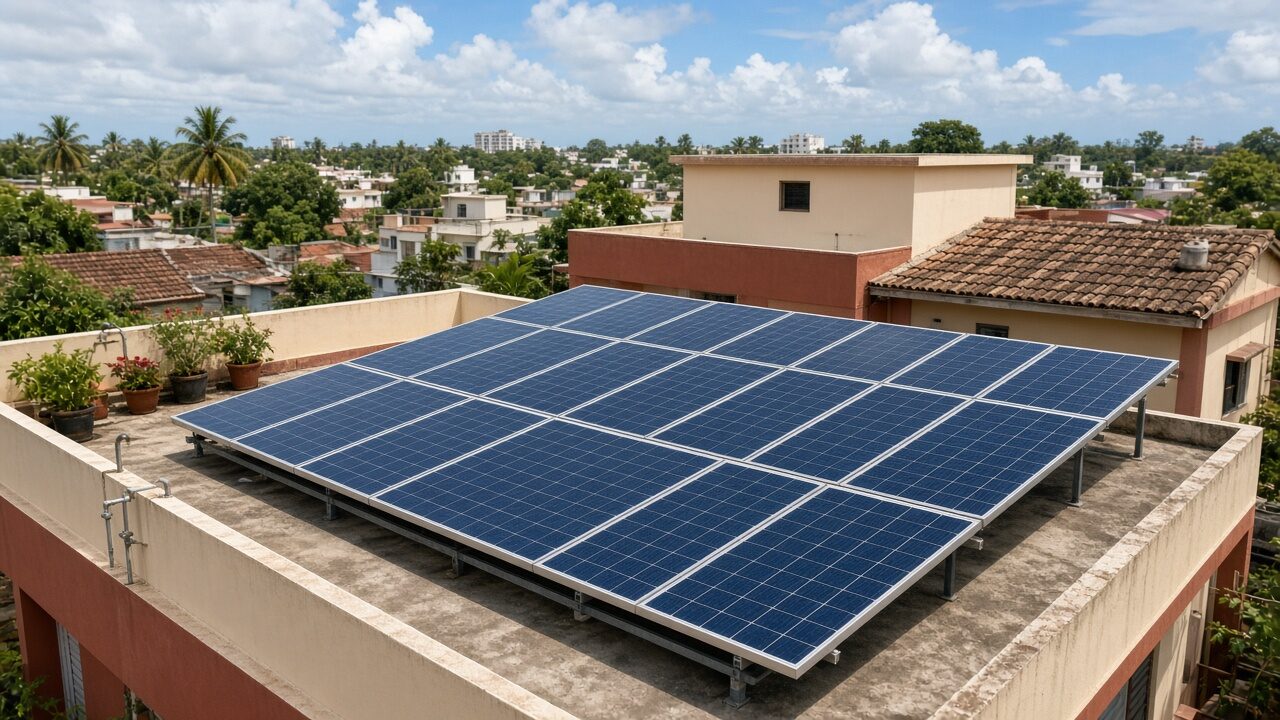


OMR, CHENNAI: Chennai’s IT corridor is entering a practical rooftop solar moment. For OMR residents—especially those in independent homes, villas, gated communities and apartment complexes—solar is no longer only an environmental choice. It is becoming a direct response to rising electricity use, heavy summer AC loads, common-area power costs and the need for long-term savings.
The strongest reason for this shift is the PM Surya Ghar: Muft Bijli Yojana. The official scheme page states that households are provided a subsidy to install solar panels on their roofs, with subsidy support covering up to 40% of the system cost.
For Tamil Nadu residents, the TNPDCL Unified Solar Rooftop Portal allows applications for rooftop solar PV with subsidy under PM Surya Ghar for domestic consumers. The same portal also supports non-subsidy rooftop solar applications and net-meter installation for measuring energy exported to the grid.
Why this matters for OMR
OMR has a specific solar advantage. The corridor has a high concentration of IT professionals, modern apartments, gated communities, villas, commercial buildings, schools, institutions and office spaces. Many homes use air conditioners, laptops, chargers, water pumps, lifts, lighting and backup systems daily. That makes electricity cost a repeated monthly pressure.
A March 2026 OMR-focused solar article described OMR’s residents as tech-savvy, high-consumption households with modern apartments and villas, making the corridor suitable for solar adoption.
For apartments around Sholinganallur and the wider OMR belt, solar can also support common-area loads. One local solar guide notes that a single apartment complex rooftop in Sholinganallur can typically accommodate a 20 kW to 50 kW system, enough to power common-area loads.
The ₹78,000 subsidy hook
The most visible price-point advantage for homeowners is subsidy support of up to ₹78,000 for eligible rooftop solar installations. A Tamil Nadu solar subsidy guide explains the structure as:
- ₹30,000 per kW for the first 2 kW
- ₹18,000 for the next 1 kW
- Maximum subsidy of ₹78,000 for systems of 3 kW and above
Check subsidy eligibility, rooftop suitability and TANGEDCO approval requirements. Subsidy rules and DISCOM processes change—confirm current steps on the national and state portals when you apply.
This means the message for OMR residents should be simple: before paying full cost for a rooftop solar system, check subsidy eligibility, rooftop suitability and TANGEDCO approval requirements.
Chennai is already moving
The rooftop solar movement is not theoretical. A recent national report stated that more than 40 lakh households had benefited from rooftop solar systems under the Surya Ghar Yojana as of 29 May 2026.
Chennai has also seen local adoption. A December 2025 report said Chennai district had received 6,394 applications under the rooftop solar scheme as of 30 November 2025, and installations had benefited 7,357 households.
What OMR homeowners should check before installing solar
A rooftop solar decision should not be based only on panel price. Residents should first check:
- Rooftop space and shade from nearby buildings
- Sanctioned load and monthly electricity usage
- Building ownership documents and TANGEDCO consumer number
- Inverter placement, safety and net-metering feasibility
- Maintenance support and post-installation service
A Chennai solar installation guide lists the typical subsidy application flow as registration on the national portal, feasibility approval from TANGEDCO, installation by an approved vendor, net-metering application, inspection and subsidy processing.
This is where many homeowners need handholding. A good installer should not simply sell panels. They should assess the site, design the system, explain ROI, guide documentation, execute safely and provide post-installation support.
Apartment associations on OMR should act faster
Apartment associations have a separate opportunity. Even if every flat owner cannot install an individual rooftop system, the association can explore solar for common loads such as corridor lighting, pumps, STP systems, lifts, security systems, clubhouse power and parking-area lighting.
A Chennai apartment solar guide notes that housing societies can install shared rooftop solar on common terraces to offset common-area electricity, while individual flat owners with allotted terrace space can install separate systems with separate net meters.
For large apartment communities in areas like Sholinganallur, Thoraipakkam, Perungudi, Navalur, Padur, Kelambakkam and Siruseri, common-area solar can become a predictable cost-reduction project.
Industrial and commercial solar on OMR
OMR is not only residential. It is also home to IT parks, commercial buildings, colleges, hospitals, warehouses, service businesses and industrial clusters around the wider Chennai region. For these users, solar is not just a subsidy story. It is an operating-cost story.
Solar EPC companies in Chennai market rooftop solar for residential, commercial and industrial users because the city has demand across all three categories. AGSunWin Energy Solutions, for example, presents residential, commercial and industrial solar EPC services in Chennai and Tamil Nadu, covering design, approvals and commissioning support.
RP Solar also positions itself as a Chennai-based solar EPC company serving residences, industries, commercial spaces and institutions.
What the next solar wave needs
The next solar wave in Chennai will depend on execution quality. Subsidy awareness may create interest, but reliable adoption requires correct system sizing, durable panels, safe mounting structures, quality inverters, proper wiring, TANGEDCO coordination, net-metering support, maintenance access and transparent pricing.
For OMR specifically, the message is clear: solar should be treated as infrastructure, not a decorative upgrade.
Chennai needs faster rooftop adoption
Chennai needs faster adoption of solar solutions and rooftop installations across domestic and industrial segments.
- Domestic rooftop solar can help households reduce long-term electricity bills, use available subsidy support and make better use of idle roof space.
- Apartment rooftop solar can reduce common-area power expenses.
- Industrial and commercial rooftop solar can help factories, offices, institutions, warehouses and IT buildings reduce operating costs and strengthen sustainability goals.
Local solar EPC options in Chennai
For Chennai-based solar support, residents and businesses can explore:
- AGSunWin Energy Solutions — residential, commercial and industrial solar EPC in Chennai and Tamil Nadu
- RP Solar — residential, commercial and industrial solar EPC solutions
- Century Solar Projects — solar EPC and on-grid solar services in Chennai
- SWELECT Energy Systems — rooftop solar for residential, commercial and industrial users
- Glyde Infra Solutions — Chennai rooftop solar and subsidy-focused residential installation guidance
Subsidy figures and savings estimates are indicative. Actual installed cost, generation and payback depend on roof structure, shading, equipment choice, tariffs and current DISCOM rules. Use a qualified EPC for site survey before committing.